


Introduction
Cardiopulmonary exercise testing (CPET) is widely recognized as one of the most comprehensive methods for evaluating cardiovascular and respiratory function during exercise. By analyzing how the heart, lungs, and muscles respond to physical stress, CPET provides valuable information for diagnosis, rehabilitation planning, and performance assessment.
However, traditional CPET systems often involve complex hardware setups, multiple cables, separate monitoring devices, and complicated software interfaces. These limitations can increase preparation time and make testing workflows more challenging for healthcare professionals.
The development of an iMac-based CPET system introduces a new approach to exercise testing by combining advanced medical analysis with an All-in-One design, Bluetooth connectivity, and a user-friendly macOS platform. The V&H CPET system integrates ECG, O₂/CO₂ analysis, SpO₂ monitoring, stress blood pressure measurement, and other functions into a single solution, providing a more efficient and flexible experience for clinical, rehabilitation, laboratory, sports, and home healthcare applications.
What Is a CPET System
A Cardiopulmonary Exercise Test (CPET) system is an advanced diagnostic platform designed to evaluate the interaction between the cardiovascular and respiratory systems during physical activity. Unlike resting examinations that only provide baseline information, CPET measures real-time physiological responses while a patient exercises on a treadmill or bicycle ergometer.
During a typical CPET procedure, patients first complete Resting Pulmonary Function Testing to assess baseline respiratory parameters. The patient performs supervised breathing maneuvers through a spirometer, allowing clinicians to evaluate lung function before exercise begins.
During the exercise phase, the patient wears a sealed facemask connected to the gas analysis system for continuous measurement of oxygen consumption (VO₂) and carbon dioxide production (VCO₂). At the same time, the system monitors ECG signals, heart rate, oxygen saturation (SpO₂), and stress blood pressure to provide a complete view of the body’s response to exercise.
Modern CPET systems are widely used in cardiology, pulmonology, rehabilitation medicine, sports medicine, and research. They help healthcare professionals assess exercise capacity, identify cardiovascular or respiratory limitations, develop personalized rehabilitation programs, and monitor treatment outcomes.
Challenges of Traditional CPET Systems
Although traditional CPET systems provide valuable clinical information, many healthcare facilities still face challenges related to equipment complexity, workflow efficiency, and flexibility.
Complex Hardware Connections
Traditional CPET setups usually require multiple independent devices, including metabolic carts, ECG systems, pulse oximeters, blood pressure monitors, and exercise equipment. These components often need various cables, connections, and calibration procedures before testing can begin.
This complicated setup increases preparation time and requires healthcare staff to manage multiple devices simultaneously. In busy clinical environments, complex hardware arrangements may reduce testing efficiency and limit the number of patients who can be evaluated each day.
Limited Portability
Many conventional CPET systems are designed for fixed laboratory environments due to their large size and complicated configuration. This limits their application in other settings, such as rehabilitation centers, hospital wards, sports facilities, or home healthcare environments.
As healthcare continues to move toward more flexible and patient-centered models, portable CPET solutions are becoming increasingly important. A more compact and integrated design allows testing services to reach more patients in different locations.
Complicated Software Interfaces
Traditional CPET software often displays information through multiple separate windows and interfaces. Clinicians may need to switch between different screens to review ECG changes, gas exchange data, exercise workload, and other physiological parameters.
This fragmented workflow can make data interpretation more time-consuming and may affect the efficiency of clinical decision-making. A modern CPET system requires a more intuitive interface that allows healthcare professionals to view important information clearly and efficiently.
Time-Consuming Clinical Workflow
From equipment preparation and sensor connection to data review and report generation, traditional CPET test can require significant time and staff involvement.
A streamlined system that reduces setup complexity, integrates multiple functions, and simplifies data analysis can help healthcare providers improve workflow efficiency while maintaining accurate diagnostic results.
How the iMac-Based CPET System Simplifies Exercise Testing
The V&H iMac-based CPET system introduces a new generation of cardiopulmonary exercise testing by combining medical-grade diagnostic capabilities with an innovative All-in-One design. By integrating macOS technology, Bluetooth connectivity, and comprehensive analysis functions, the system addresses many limitations of conventional CPET solutions.
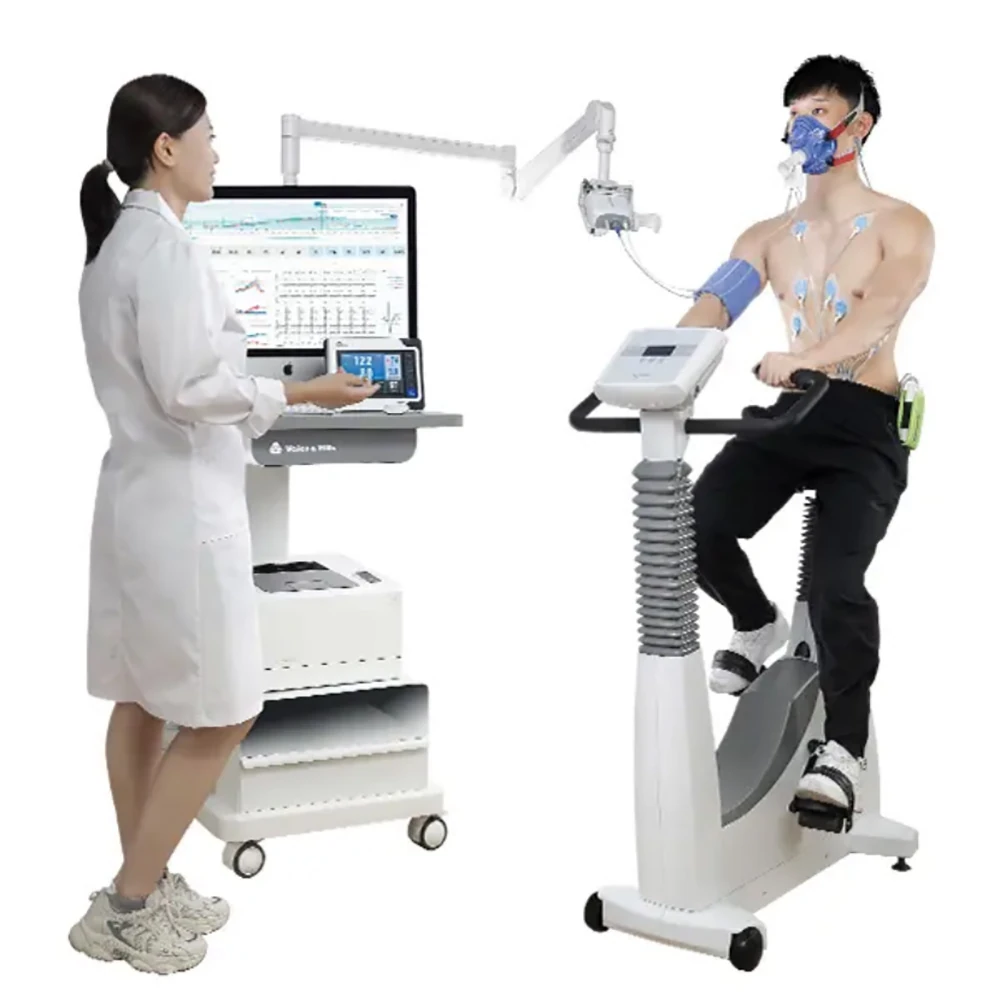
Native macOS Platform and All-in-One Design
The V&H CPET system is the first Cardiopulmonary Exercise Test system running on Apple macOS, combining the advantages of Apple’s computing platform with advanced medical testing technology.
The All-in-One design provides a cleaner and more efficient testing environment by integrating essential CPET functions into a single system. Instead of relying on multiple separate devices, healthcare professionals can manage testing procedures and review results through one unified platform.
The innovative CPET software display features a distinctive timeline design that dynamically integrates the Past, Present, and Future within a single frame. This allows clinicians to understand changing physiological responses throughout the entire exercise process more efficiently.
Compared with traditional interfaces that require users to compare different screens manually, the V&H timeline design provides a clearer overview of patient performance and helps clinicians identify important trends during testing.
Bluetooth Wireless Connectivity for a Cleaner Testing Workflow
One of the key advantages of the V&H iMac-based CPET system is its Bluetooth connection technology. Traditional CPET systems often rely on multiple physical cables to connect ECG devices, pulse oximeters, blood pressure monitors, gas analysis equipment, and the main processing unit. These connections can make the testing environment complicated and increase preparation time.
The V&H CPET system uses Bluetooth connectivity to simplify communication between monitoring devices and the main platform. By reducing cable dependency, the system creates a cleaner and more organized testing environment while improving flexibility during patient preparation and exercise procedures.
Wireless connectivity also makes the system easier to move between different clinical locations. Healthcare professionals can prepare patients more efficiently without managing complicated cable arrangements, helping improve overall workflow and patient experience.
For patients, a cleaner setup with fewer wires can reduce anxiety during testing and create a more comfortable examination process. For healthcare providers, the simplified configuration helps save preparation time and allows more efficient use of CPET equipment.
Integrated Diagnostic Functions in One CPET System
A modern CPET system requires accurate measurement of multiple physiological parameters at the same time. The V&H iMac-based CPET system integrates essential testing functions, including ECG monitoring, O₂/CO₂ gas exchange analysis, SpO₂ monitoring, and stress blood pressure measurement, into one complete platform.
During exercise testing, the system continuously collects and analyzes cardiovascular and respiratory data to provide a comprehensive assessment of patient performance. The integration of multiple parameters allows clinicians to evaluate the relationship between heart function, lung function, oxygen utilization, and exercise capacity.
The system also includes a comprehensive range of advanced analysis functions:
- ERGO – Supports exercise workload management and ergometer control.
- WASSERMAN-9 – Provides the classic nine-panel CPET analysis for comprehensive interpretation.
- AT (Anaerobic Threshold) – Helps identify anaerobic threshold through exercise and gas exchange analysis.
- INTRABREATH – Provides detailed breath-by-breath gas exchange evaluation.
- QT CALC – Supports QT interval calculation during exercise testing.
- RESP-DIVER – Enables advanced respiratory pattern analysis.
- CALORIMETRY – Provides energy expenditure measurement through indirect calorimetry.
- WORK-LOAD – Evaluates workload and exercise performance.
- DATA-LIST – Supports data management and reporting.
By integrating these functions into a single system, the V&H CPET platform eliminates the need for multiple independent software solutions. Clinicians can access, analyze, and manage different types of exercise data within one unified workflow.
High-Resolution Display for Accurate Clinical Observation
Accurate interpretation of CPET results requires clear visualization of complex physiological data. The V&H iMac-based CPET system takes advantage of a high-resolution display to present detailed information with excellent clarity.
The rich color display helps highlight subtle variations in ST-segment changes, allowing clinicians to observe ECG changes more effectively during exercise testing. Since ST-segment variations can provide important information related to cardiac function, clear visualization is essential for accurate clinical assessment.
The large and detailed display also allows multiple parameters, including ECG waveforms, gas exchange data, workload information, and physiological trends, to be viewed together. This improves situational awareness during testing and helps clinicians make decisions based on a complete understanding of patient responses.
By combining advanced visualization technology with medical testing functions, the V&H system provides a more efficient diagnostic experience for healthcare professionals.
Portable Design for Flexible Clinical Applications
Unlike traditional CPET systems that are often limited to dedicated testing laboratories, the V&H iMac-based CPET system features a portable All-in-One design that supports a wider range of usage scenarios.
The compact design allows the system to be used across different environments, including:
- Clinical departments
- Rehabilitation centers
- Medical laboratories
- Hospital wards
- Sports performance facilities
- Home healthcare settings
The portability of the system provides healthcare providers with greater flexibility. For example, hospitals can move the equipment between cardiology departments, rehabilitation areas, and other clinical locations according to testing requirements.
In sports medicine, the system can support exercise assessment in both indoor and outdoor environments. For rehabilitation programs, it enables more convenient patient evaluation and progress monitoring. In home healthcare applications, the portable design creates new possibilities for providing advanced cardiopulmonary assessment outside traditional medical facilities.
Frequently Asked Questions
What is an iMac-based CPET system?
An iMac-based CPET system is a Cardiopulmonary Exercise Test platform that runs on Apple macOS and integrates exercise testing, ECG monitoring, gas exchange analysis, SpO₂ monitoring, and stress blood pressure measurement into one system. The V&H CPET system combines an All-in-One design with Bluetooth connectivity to simplify modern exercise testing.
How does Bluetooth improve CPET testing?
Bluetooth connectivity reduces cable complexity by allowing monitoring devices to communicate wirelessly with the main CPET platform. This helps simplify setup, improve portability, and create a cleaner testing environment.
Can the V&H CPET system perform pulmonary function testing?
Yes. The V&H CPET system includes Resting Pulmonary Function Testing, allowing patients to complete supervised breathing maneuvers through a spirometer to evaluate baseline respiratory parameters before exercise testing.
Where can the V&H CPET system be used?
The V&H CPET machine can be used in clinical environments, rehabilitation centers, laboratories, hospital wards, sports facilities, and home healthcare settings. Its portable design supports both indoor and outdoor applications.
Conclusion
The V&H iMac-based CPET system represents a new approach to cardiopulmonary exercise testing by combining an innovative All-in-One design with advanced medical analysis technology. Through macOS operation, Bluetooth connectivity, integrated monitoring functions, and portable design, the system simplifies traditional CPET workflows and expands testing possibilities across multiple healthcare environments.
By bringing together ECG, gas exchange analysis, pulmonary function testing, SpO₂, stress BP, and advanced CPET modules in one platform, the V&H system provides healthcare professionals with a more efficient and flexible solution for exercise testing.
As the demand for smarter, more accessible diagnostic technology continues to grow, the iMac-based CPET system offers a modern way to improve clinical efficiency, enhance patient experience, and support the future development of cardiopulmonary assessment. If you are interested in our products, please feel free to contact us for more information and a quote.
Post time: July 10, 2026


