


A smaller ECG device can still provide 12 leads. In a 12-lead ECG vs single-lead ECG comparison, the central difference is electrical coverage: a standard 12-lead examination provides 12 views, while a single-lead tracing provides one.
That difference affects which questions the recording can help a clinician assess. A single lead can support a defined heart-rate or rhythm task. A standard 12-lead recording adds spatial information used in broader assessment of rhythm, conduction, and possible ischemic changes. Neither the device size nor an automated result establishes a diagnosis on its own.
For equipment buyers, product descriptions can blur these distinctions. A watch, handheld recorder, tablet-based system, and examination-room machine may all carry the ECG label. They can differ in lead coverage, recording duration, software, and intended use.
This guide separates those requirements so clinical, technical, and purchasing teams can compare the same task. It draws on technical references and device makers’ own information. It turns the differences into practical questions for a purchasing brief. This guide explains equipment choices; it does not give medical advice for any one patient.
Key takeaways
- A conventional 12-lead ECG uses 10 electrodes to produce six limb and six chest leads.
- Single-lead recordings can support defined rhythm tasks; they do not supply the same spatial information as a standard 12-lead examination.
- Lead count and recording duration are separate specifications. A wearable ECG feature is not automatically continuous recording.
- Portable 12-lead systems exist. Compare the exact acquisition configuration, software, and intended use before choosing equipment.
12-lead ECG vs single-lead ECG: the core differences
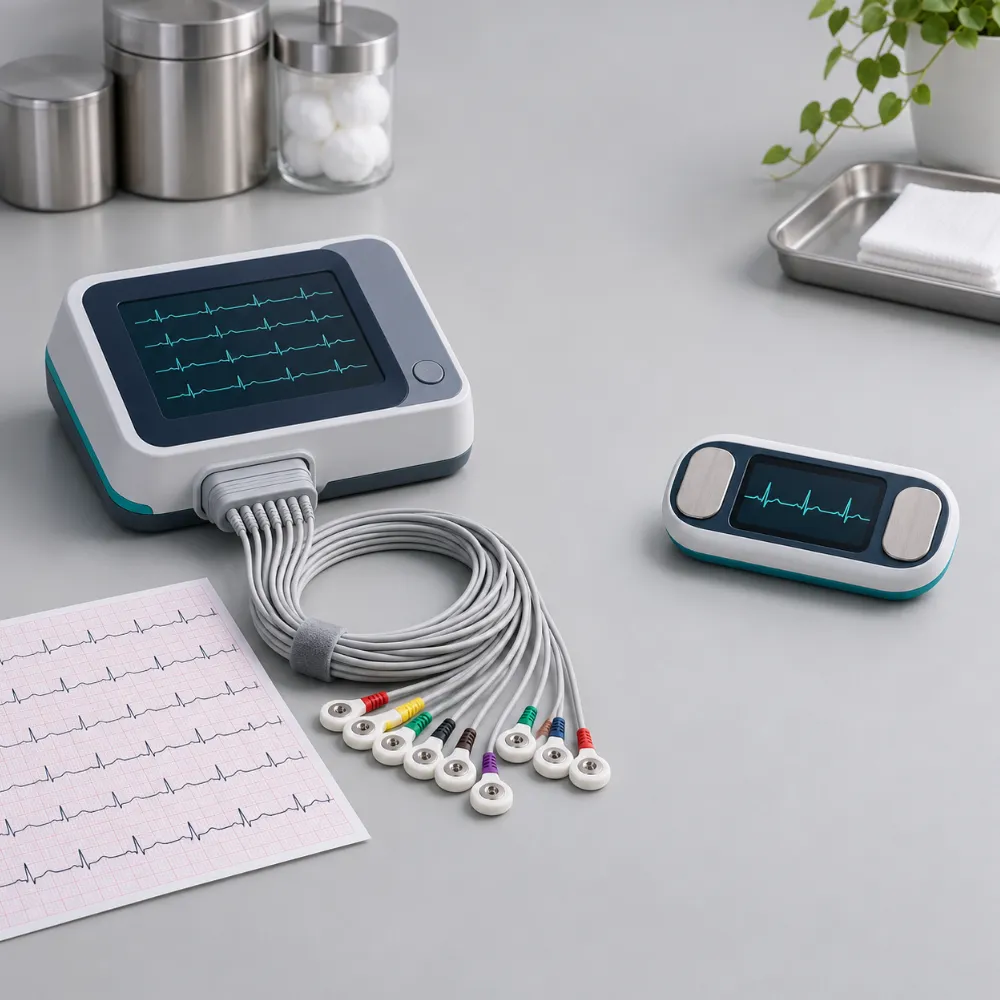
Start with the information your service needs, then compare how the equipment obtains and presents it.
| Comparison point | Standard 12-lead ECG | Single-lead ECG |
|---|---|---|
| Electrical views | 12 named leads | One lead, with its orientation determined by the device and placement |
| Electrode configuration | Conventionally 10 electrodes on limbs and chest | Device-specific contacts or electrodes; one lead does not mean one electrode |
| Information available | Rhythm plus spatial patterns across limb and chest leads | A waveform useful for defined rate and rhythm assessment |
| Recording duration | Depends on the examination and equipment | Depends on the device and recording mode |
| Portability | Can include compact, computer-based, or wireless configurations | Can include handheld or wearable formats |
| Interpretation | Qualified review in clinical context | Qualified review and device-specific limits still matter |
The table compares configurations, not clinical accuracy percentages. A clear single-lead tracing can be useful for its intended task without replacing a different examination.
Review the PC-based ECG range when your requirements include a computer-based examination and reporting workflow.
What do leads and electrodes actually measure?
An electrocardiogram, or ECG, records electrical activity associated with the heartbeat. Electrocardiography is the recording process. EKG is another abbreviation for the same examination.
An electrode is a physical contact with the body. A lead is an electrical view formed from electrode signals and a defined reference. Count the contacts and the views as separate items. The number of adhesive contacts does not directly tell you how many leads the system displays.
Why 10 electrodes produce 12 leads
A conventional setup uses four limb electrodes and six chest electrodes. LITFL’s ECG lead reference explains the resulting 12 leads:
- Limb leads I, II, III, aVR, aVL, and aVF provide six frontal-plane views.
- Chest leads V1 through V6 provide six horizontal-plane views.
The ECG plots electrical signals over time. It does not take a photograph or make a three-dimensional image of the heart. The leads let clinicians compare the same beat from different angles.
Correct placement helps staff get a useful recording. Follow training, local procedures, and the current instructions for use. A buying guide can identify the electrode setup. It cannot replace those placement instructions.
Why one lead is still useful
A single lead supplies a waveform over time. It can show the spacing and pattern of beats during that period. What a clinician can learn depends on the lead angle, signal quality, device features, and the question they need to answer.
One lead does not show every angle in a standard examination. More time adds more beats to review. It does not create the missing chest and limb views.
What can each ECG show, and what can it miss?

A standard 12-lead recording shows electrical activity from more angles than a single-lead tracing. This is its added spatial information. It matters when a clinician needs to compare patterns across leads, beyond the timing of beats in one waveform.
The Merck Manual’s electrocardiography overview describes ECG uses in evaluating rhythm, conduction, and coronary ischemia, among other conditions. Those uses require clinical interpretation. They are not guarantees that every abnormality will appear on one recording.
Rhythm information versus spatial information
A single-lead device can support a specific rhythm workflow when its intended use and evidence match that task. For example, Apple’s ECG app classifies certain recordings for atrial fibrillation, or AFib. That is a device-specific function with defined limits, rather than a universal capability of every recorder.
A 12-lead examination also provides rhythm information. Its additional views allow comparison of waveform patterns across the standard lead set. A single-lead recording should not be substituted when the clinical service requires that standard examination.
Hypothetical example: Morgan coordinates equipment for a clinic with two examination rooms. Their draft request lists both routine 12-lead examinations and patient-triggered rhythm recordings outside appointments. During a requirements meeting, the clinical team separates those into two workflows.
Morgan then requests specifications for each task instead of assuming one compact recorder covers both. The outcome is a clearer purchasing brief, not a claimed improvement in diagnosis or patient outcomes.
Ask what an accuracy claim actually measures
There is no single accuracy percentage that meaningfully compares every 12-lead and single-lead device. Ask what was tested before comparing the headline number:
- Target: Which rhythm, condition, or measurement did the study assess?
- Device: Which recorder and software version were used?
- People: Who took part, and do they match the intended users?
- Reference: What test or expert assessment supplied the comparison?
- Missing results: Were poor or unreadable strips included in the reported figures?
Sensitivity tells you how often a test finds the target condition when it is present. Specificity tells you how often it correctly identifies people without it. Both figures apply to the task that was tested. They do not automatically apply to other conditions or settings.
A study may report results only for strips its software could classify. What happened to the rest? Ask how often the system could not give a result, and how the care team handles those strips. A headline percentage leaves out that part of daily work.
A normal result has limits
Apple’s ECG app documentation states that its sinus rhythm classification applies to that particular recording. It also states that the app cannot detect a heart attack. Do not treat an automated normal label as confirmation that a person has no heart condition.
A standard ECG also captures activity during a particular interval. A clinician decides whether symptoms and other findings call for further assessment. If someone suspects a heart attack, they should contact emergency services immediately rather than wait for another wearable reading.
Recording time is a separate decision
Lead coverage tells you which electrical views the system records. Duration tells you when, and for how long, it records them. Put both in the equipment brief.
A routine resting ECG is a brief examination. As Merck explains, a short recording may not capture an intermittent rhythm disturbance. Longer observation can address that time gap, but it does not make a single electrical view equivalent to the standard 12-lead set.
Wearing a device is not the same as recording ECG continuously
Apple describes its ECG app recording as a 30-second measurement with a waveform similar to Lead I. That is an example of a user-initiated recording. It does not establish continuous ECG capture throughout the time someone wears a watch.
For other wearable or ambulatory equipment, inspect the actual recording mode:
- Spot check: Does the user start a short recording?
- Event record: What event starts or saves the segment?
- Continuous record: Does the quoted mode keep ECG throughout the stated period?
Ask how recording begins and what data the review team can retrieve. Use the answers for that exact model, rather than assuming a mode from its shape.
Hypothetical example: Alex prepares a remote-follow-up proposal for 20 participants. Their first equipment list assumes that wearing a watch all day produces an all-day ECG record. After reviewing the selected app’s 30-second recording instructions, Alex changes the requirement to distinguish scheduled spot recordings from continuous monitoring.
The clinical lead can now evaluate those options separately. No monitoring benefit is assumed from how long the watch stays on the wrist.
Compare lead count and duration together
Use a two-part requirement such as “standard 12-lead acquisition during an examination” or “single-lead event recording under the agreed clinical protocol.” These descriptions give suppliers more useful direction than “portable ECG” alone.
Holter and other ambulatory systems require their own configuration review. Do not assume every Holter is single-lead, every patch is continuous, or every long-duration device records the same signals. The exact lead arrangement and supported recording period belong together in the technical proposal.
Recording time, storage, and review time are three separate fields:
- Recording: When does ECG capture start and stop? What mode was used?
- Storage: What record is kept, and how can the team retrieve the original waveform?
- Review: Who receives it, and is it reviewed later or within a defined service period?
A device may save data for later transfer. Another setup may send it remotely. Neither description alone establishes a live monitoring service. Check the full data path before using that term.
12-lead ECG vs single-lead ECG in a purchasing brief

Put the requirements in a brief that care teams, engineers, and buyers can review together. Start with the examination your service plans to offer. Then follow the data from recording to the final report.
Define the recording and intended use
Name the required lead set and recording mode. If you need a standard 12-lead examination, ask how the quoted system records its signals. Check that this method matches the clinical protocol.
A six-lead product, a reconstructed lead display, and a conventional 12-lead acquisition should not be treated as identical because the report has multiple rows. Ask which signals are acquired, which are calculated or reconstructed, and what validation supports the proposed use. Conventional 12-lead systems also derive leads from electrode signals; calculation alone does not establish inferiority.
The aim is to identify the actual method and evidence. Avoid replacing that review with a rule based on the number of printed traces or physical contacts.
Inspect a usable recording and its review pathway
Request a sample waveform and report from the quoted system using test data. Follow the record through each stage. A summary label on a screen is only one part of the demonstration.
| Review stage | What the team should check |
|---|---|
| Identify the record | Patient or test identifier, date, time, and the device or recording mode |
| Inspect the signal | Relevant waveforms, lead names, timing, settings, and visible signal quality |
| Handle a poor strip | How staff identify an unreadable record, note the problem, and decide the next step under local procedures |
| Review the findings | How a qualified professional checks automated findings and adds comments |
| Finalize the report | Who approves it, where it is saved, and how the approved version is retrieved |
For a remote service, state who receives a record and when they will review it. An upload feature alone does not establish a staffed monitoring service or emergency response. The clinical team should define the review process before it becomes a purchasing requirement.
Match the host device and data workflow
A phone, tablet, or computer is a platform choice. It does not determine lead count. List the components of the proposed system together:
- Recorder: Exact model and the lead set it acquires.
- Application: Software name, version, and license scope.
- Host: Supported operating-system versions and the computer, phone, or tablet requirements.
- Accessories: Patient cables, electrodes, power supplies, and any printing equipment needed.
Compare the host workflow: The Android and PC-based ECG workflow comparison explains a separate selection question after your lead requirements are clear.
For report handling, use concrete checks rather than a general request for connectivity:
- Ask which file formats the quoted software exports and whether the waveform remains available for review.
- Identify how staff transfer a record and confirm the right patient and destination.
- If a hospital interface is required, request its documentation and an agreed demonstration.
- Establish how your organization will control access, retain records, and retrieve them later.
Bluetooth or a PDF report does not, by itself, establish compatibility with an institutional record system. These are requirements to evaluate, not capabilities proved by the phrase “connected ECG.”
Compare the complete cost and documentation
A recorder price cannot describe the cost of a complete service. Ask suppliers to itemize:
- Recorder, patient cable, electrodes, and replacement accessories
- Required computer or mobile host, if supplied
- Software licenses and optional analysis or reporting functions
- Storage, transfer, or interface components needed for the project
- Training, warranty, maintenance, and technical support arrangements
Compare the same scope. A lower device price may cover a different examination or omit parts your service needs. No fixed price ratio between single-lead and 12-lead equipment can replace current quotations.
Keep the documents with the proposal so all reviewers see the same equipment:
- Current instructions for use for the exact recorder and software.
- Applicable regulatory documents for the model and destination market.
- A list of included parts and any options the proposed workflow requires.
- Written service terms, including the scope of training, warranty, and support.
Check that product identifiers, intended use, and quoted components match across the documents. A company-level certification claim does not establish authorization for every product or territory.
Frequently asked questions
What can a one-lead ECG show?
It provides one electrical waveform. This can help a clinician assess rate and rhythm during the recording. The measurements and automated labels depend on the exact device and its intended use. One lead does not provide every view in the standard 12-lead set.
Why is it called a 12-lead ECG if there are 10 electrodes?
The number refers to electrical views rather than physical contacts. Four limb electrodes and six chest electrodes produce the conventional 12 leads. The resulting lead set contains six limb and six chest views.
Can a smartwatch replace a standard 12-lead examination?
A single-lead smartwatch feature does not provide the standard lead set. Check its usefulness for the task its maker documents, such as a defined rhythm recording. It should not replace a prescribed 12-lead examination. Do not use it to dismiss concerning symptoms.
Is a portable ECG always single-lead?
No. Portability describes the equipment format. Lead count describes its electrical coverage. A compact recorder connected to a compatible tablet or computer can offer 12-lead acquisition, depending on the exact model and configuration.
Are ECG and EKG different technologies?
No. Both abbreviations refer to electrocardiography or an electrocardiogram. When comparing quotations, focus on the lead set, recording mode, intended use, software, and accessories rather than which abbreviation appears in the product name.
Choose the configuration around the examination
The 12-lead ECG vs single-lead ECG decision starts with the clinical question and recording requirements. Use the required electrical views and time coverage to define the examination, then evaluate the complete equipment and review workflow.
Vales and Hills Biomedical Tech. Ltd. (V&H) describes a portable 12-lead Android configuration in its iCV200 Android product information. The listing names Bluetooth connectivity and the aECG application. It illustrates why a mobile format should not be assumed to mean single-lead acquisition.
For a purchase, confirm the current model documentation, supported host and application versions, patient accessories, and applicable destination-market requirements. Keep manufacturer-described features separate from evidence of clinical performance. Review software, report handling, and service terms with the people who will use and support the system.
Request current ECG specifications with your examination type, lead and duration requirements, preferred platform, and destination market. Those details give V&H a concrete basis for discussing a configuration and an itemized quotation.
Post time: November 23, 2026


