


For clinics and hospitals that perform exercise tolerance testing, choosing the right 12-lead stress ECG machine is one of the more consequential purchasing decisions a cardiology or diagnostic department can make. The device sits at the center of a workflow that connects patients, physicians, and clinical records, so a poor fit is felt across the whole process rather than in one isolated step.
This guide walks through the features that matter most when evaluating a stress ECG machine, and it does so from the perspective of a buyer rather than a vendor. The aim is to give you a practical checklist you can use whether you are equipping a new department, replacing an aging unit, or standardizing equipment across multiple sites.
Why the Right Stress ECG System Matters
A 12-lead stress ECG system does far more than display a moving waveform. It coordinates the patient’s effort on a treadmill or ergometer with continuous cardiac monitoring, and it must do this reliably over the entire session, from the resting baseline through peak exertion and into recovery. Any interruption, lag, or loss of signal during those moments undermines the test’s diagnostic value.
Because stress testing is physically demanding for the patient and time-sensitive for the staff, the system’s usability directly affects how smoothly a department runs. A machine that is difficult to set up, slow to connect, or awkward to read creates friction at every appointment. A well-designed system, by contrast, lets clinicians focus on the patient and the physiology rather than on the equipment.
Key Features to Evaluate
When comparing systems, it helps to organize the evaluation around a handful of functional areas. The sections below cover the features that most directly shape day-to-day clinical use.
Signal Quality and Channel Coverage
The foundation of any diagnostic ECG is the integrity of the signal itself. A 12 channel ECG machine records the heart’s electrical activity from multiple leads simultaneously, and the quality of that acquisition determines how confidently a physician can interpret the tracing. Look for a system that maintains a clean, stable signal even as the patient moves during exercise, since motion artifact is one of the most common sources of ambiguous readings.
Wireless Connectivity
Modern stress testing increasingly benefits from wireless operation. A wireless 12 lead ECG machine removes the tether of cables that traditionally connected the patient to the acquisition hardware, which means the patient can move more naturally on the treadmill or cycle ergometer. This reduction in physical constraint is not merely about comfort; it can also translate into fewer motion-related artifacts and a more realistic exercise response.
Wireless also simplifies the operator’s side of the test. When the acquisition device communicates with the recording software without a physical link, setup is faster and the testing area stays tidier. For a busy lab that runs multiple tests a day, those small time savings accumulate.
Bluetooth Reliability and Speed
Within the wireless category, the specific connection technology matters. Bluetooth ECG machines have become common, but the version of Bluetooth in use affects how quickly the device pairs and how stable the connection remains throughout a session. Newer Bluetooth standards generally offer faster pairing and more robust data throughput, which supports the high-rate, uninterrupted signal transmission that a 12-lead recording demands.
A buyer should ask directly how the device establishes its connection and how it behaves if that connection is momentarily interrupted. Stability under real-world conditions, not just in a demonstration, is what keeps a stress test from being compromised mid-procedure.
Reporting and Documentation
The test does not end when the patient steps off the treadmill. A stress ECG machine with reporting capabilities turns the recorded data into a usable clinical document. The quality of that reporting matters: a good system should let the physician review the full test, annotate findings, and produce a report that fits the facility’s existing documentation and record-keeping workflow.
Consider how the report is generated, what it includes, and whether it can be exported or stored in a format that integrates with your practice’s systems. Reporting that is awkward or incomplete creates downstream work, while well-structured reporting closes the loop cleanly between test and diagnosis.
A Closer Look at a Modern Approach: vhStressECG
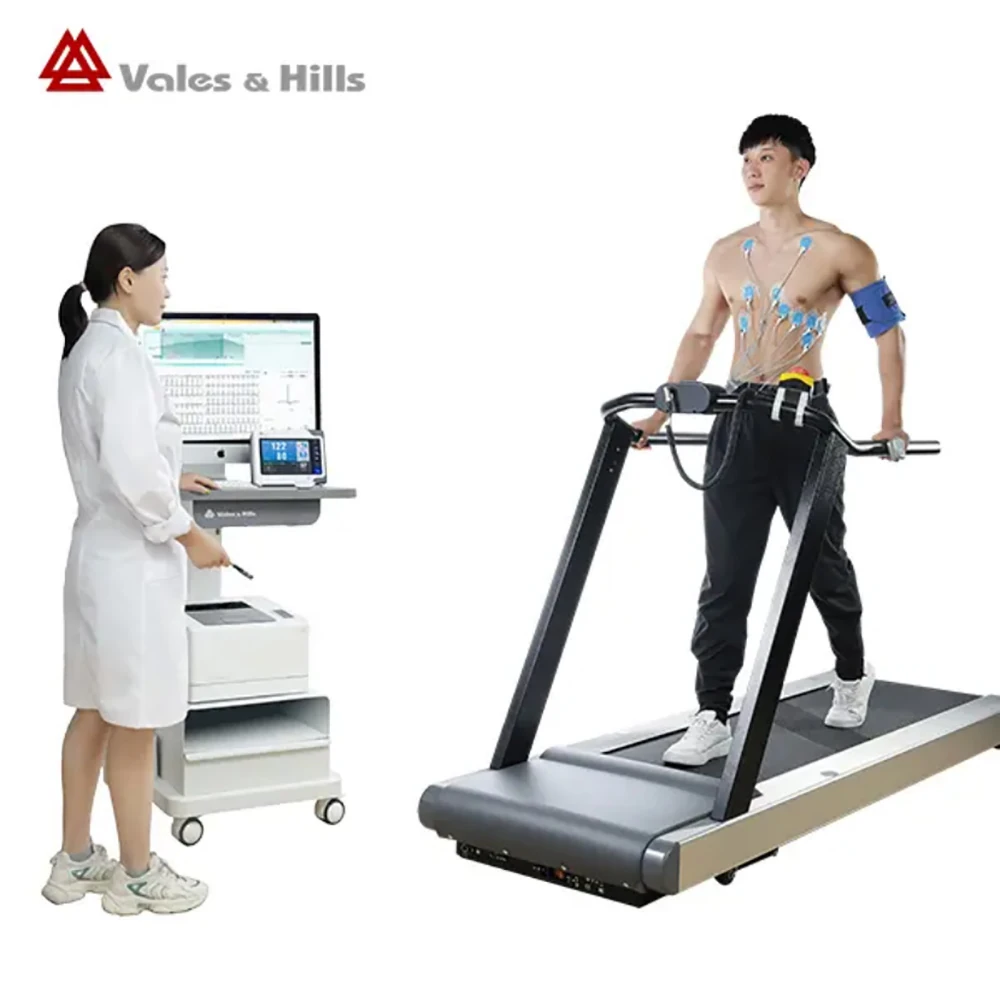
Having covered the general criteria, it is worth examining a specific system that illustrates how these features come together in practice. vhStressECG is an all-new designed stress test system developed by Vales & Hills Biomedical Tech. Ltd., and it offers a useful reference point for buyers evaluating modern options.
vhStressECG is an all-new professional stress test ECG system based on Mac OS for clinical application, meticulously designed by Vales & Hills Biomedical Tech. Ltd. over a period of two years. It is the first Mac OS based stress test system with a user-friendly interface developed by the company. Compared to previous Windows-based stress test systems, this software maintains the basic functions of stress testing while greatly improving the interface and operation, streamlining the working process and enriching the user experience.
Time Tracking Across the Entire Test
One of the system’s defining features is its time axis, which covers the whole stress test process from pretest to recovery. The doctor can clearly see the time of each stage or level under a preset stress protocol, and whether that stage or level is past, current, or upcoming. This gives the clinician a continuous view of where the test stands at any moment, rather than a series of disconnected snapshots.
Building on this time axis, vhStressECG presents an overview interface that displays important information such as ECG, heart rate, BPM, METs, ST, events, slope, speed, and power at each time point, all on a single screen in an overall and intuitive way. This consolidated view reduces the need to switch between windows or reconstruct the test mentally.
Bluetooth 5.0 Connectivity
For connection between the acquisition device and the software, vhStressECG adopts the latest Bluetooth 5.0 technology. This enables the system to connect to the ECG acquisition box at the fastest speed while ensuring high-speed and stable ECG signal transmission. The wireless Bluetooth connection between the acquisition box and the vhStressECG app on Mac also increases comfort for the patient and convenience for the operator, since neither is constrained by a physical cable.
A Stylishly Designed Device
The software works with a stylishly designed ECG device that combines a smooth appearance and lines with a practical choice of colors. The device is available in three fashionable color options: health green, emergency red, and minimal grey. While appearance is secondary to clinical performance, a device that is pleasant to handle and visually coordinated with the testing environment contributes to a more professional overall impression for both staff and patients.
Conclusion
Choosing the right 12-lead stress ECG system requires more than comparing basic specifications. Hospitals and clinics should consider signal acquisition, wireless connectivity, Bluetooth performance, software functionality, and the efficiency of the overall testing workflow. These factors work together to determine whether a system can meet the practical demands of clinical exercise testing.
For medical facilities looking for a modern solution, vhStressECG combines Mac OS-based software, Bluetooth 5.0 connectivity, and time-based test tracking in one system. Its overview interface also brings key exercise testing information together, helping clinicians follow the test process more intuitively.
If you are evaluating a 12-lead stress ECG system for your hospital, clinic, or medical equipment distribution business, contact the Vales & Hills team to learn more about vhStressECG, its features, and its suitability for your application.
Frequently Asked Questions
1. What is a 12-lead stress ECG system used for?
A 12-lead stress ECG system records and displays the heart’s electrical activity during exercise testing, allowing clinicians to monitor ECG changes throughout different stages of physical exertion and recovery.
2. What is the advantage of a wireless stress ECG machine?
A wireless stress ECG machine reduces the need for physical cables between the patient and acquisition equipment, providing greater freedom of movement during treadmill or cycle ergometer testing.
3. What should buyers consider when choosing a stress ECG machine?
Buyers should evaluate signal quality, channel configuration, connection stability, software functionality, data presentation, and compatibility with their clinical workflow.
Post time: November 19, 2026


