


Introduction
The electrocardiogram has been a core diagnostic tool for nearly a century. At its heart, it records the tiny electrical signals that coordinate each heartbeat and turns them into a waveform a clinician can read. What has changed in recent years is not the biology but the pipeline: how those signals are collected, moved, and stored. Modern systems replace carts, cables, and paper printouts with compact hardware and software-driven workflows. Understanding that pipeline helps buyers choose equipment that fits real clinical and field settings. This article walks through each stage – capture, transmission, mobile software, and reporting – before looking at one concrete example of a portable system built for Android.
How an ECG Signal Is Captured
Every heartbeat begins with an electrical impulse in the heart’s natural pacemaker. As the impulse spreads, body tissues conduct it to the skin, where surface electrodes detect the voltage changes. A standard 12-lead recording places ten electrodes at defined positions on the limbs and chest. From those ten contact points the system derives twelve views, or “leads,” of the heart’s electrical activity. Recording them at the same moment matters: it gives a synchronized picture rather than a sequence of snapshots. The quality of the capture depends on stable electrode contact, correct placement, and a front-end that can resolve millivolt-level signals against background noise.
From Wired to Wireless: How ECG Data Travels
Traditional setups ran a thick communication cable between the acquisition box and the recording computer. A Wireless ECG Machine removes that physical link. Instead, the acquisition hardware sends digitized samples to a nearby device over a short-range radio link, most commonly Bluetooth. This change is practical, not cosmetic. Fewer cables mean less clutter in tight rooms, easier cleaning, and the freedom to position the patient and the screen independently. The trade-off is that wireless links need pairing, stable power, and a clear signal path – all manageable with sensible design. For mobile clinics, home visits, and satellite sites, cutting the cable is often what makes a compact ECG practical in the first place.
Why Android Compatibility Matters for ECG Workflow
An Android ECG Machine puts ECG software on a smartphone or tablet that staff know how to use, rather than on a proprietary workstation. That choice lowers training cost and lets the same device double as a recorder, viewer, and note-taker. Android’s open ecosystem also simplifies integration with printers, cloud storage, and hospital systems. The software can run on hardware the facility already owns, which shortens deployment and reduces the number of single-purpose boxes on a desk. For distributed care – multiple sites, traveling technicians – a phone-based workflow is far easier to scale than fixed carts.
What a 12-Channel Recording Brings to the Table
The “12-lead” standard exists because no single view shows the whole heart. A 12 Channel ECG Machine captures all twelve derived leads in a single synchronized sweep. That breadth supports the detection of regional problems – for example, changes tied to a specific coronary territory – that a reduced-lead device might miss. Synchronized capture also makes the tracing suitable for automated analysis and for comparison against prior studies. For routine adult ECG examinations, the 12-lead ECG remains a common clinical practice. Portable devices that support 12-lead acquisition allow clinicians to continue using familiar ECG interpretation methods.
Turning Signals into a Digital Report
Collecting a waveform is only half the job. A Digital ECG Machine stores the tracing as data, not just as an image on paper. That distinction unlocks search, archival, and re-analysis. The next step is interpretation: many systems run an algorithm that flags likely findings and proposes a statement, which a clinician then reviews and edits. A true **ECG Machine With Reporting** goes further and produces a finished document – the waveform plus the interpreted statement plus patient and study metadata – in a portable format such as JPG or PDF. From there the report can be shared by email, sent to cloud storage, or pushed into an electronic medical record. The report, not the printout, becomes the unit of care that travels with the patient.
A ECG Machine With Reporting therefore closes the loop: it does not stop at a trace, but delivers a clinician-ready document that can move between locations and systems without being rescanned or retyped.
iCV200: A Portable 12-Lead Bluetooth ECG Built for Android
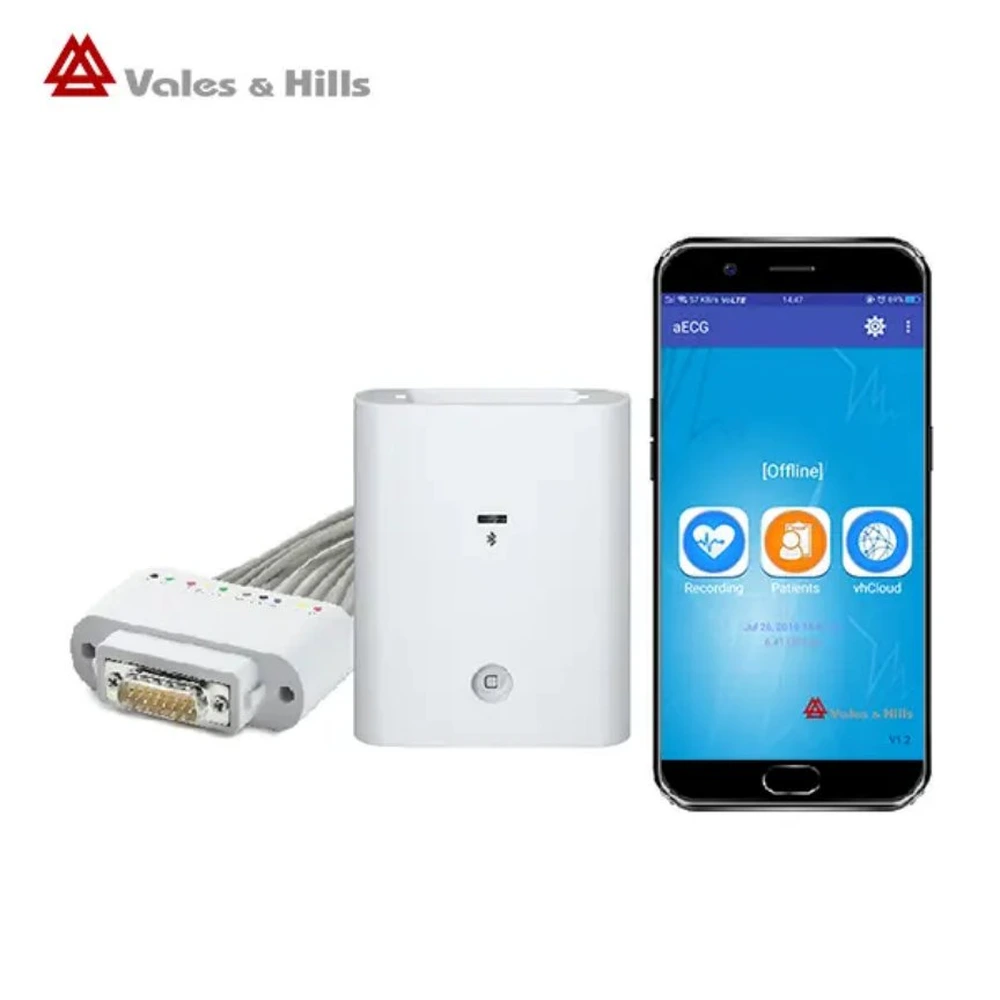
The iCV200 is a portable resting ECG system designed around the workflow described above. It records all twelve channels simultaneously and connects to an Android smartphone or tablet over Bluetooth. The acquisition side uses a 10-lead patient cable, and the companion aECG app handles display, storage, and review on the mobile device.
Recording flexibility is a core feature. The iCV200 supports a wide range of capture lengths – 10, 20, 30, 60, 90, 120, and 150 seconds, plus 3, 5, 10, and 60 minutes – so the same device suits a quick resting trace or a longer observation window.
On the software side, aECG provides automatic interpretation of the recording and lets the reviewing clinician add or edit comments before finalizing. Reports can be printed on a Bluetooth thermal printer, or exported as JPG or PDF. Finished reports can be shared by email and to cloud services including OneDrive, Google Drive, and Dropbox, as well as through social channels, and can be uploaded to an electronic medical record system. That end-to-end path – capture, interpret, print or export, and share – is what makes the iCV200 a practical fit for clinics, mobile teams, and facilities that need ECG data to move easily between locations and systems.
Frequently Asked Questions
Can a wireless ECG machine work without cables?
Yes. A wireless ECG machine records the heart’s electrical activity and sends the digitized signal to a nearby device, such as a phone or tablet, over a short-range radio link like Bluetooth instead of a physical cable. This reduces clutter and lets the patient and the screen be positioned independently.
Can an ECG machine work with an Android phone or tablet?
Yes. An Android-compatible ECG system runs its software on a smartphone or tablet, so staff can use familiar hardware for capture, viewing, and reporting without a dedicated workstation.
Why record all twelve leads at once?
Recording all twelve leads in a single synchronized sweep gives a complete view of the heart’s electrical activity, which supports detection of regional issues and keeps the output compatible with standard reading and comparison practices.
What does “ECG machine with reporting” mean?
It means the device produces a finished document – the waveform, an interpreted statement, and study metadata – typically as JPG or PDF, ready to print, share, or upload to a record system.
How are ECG reports shared?
Reports can be exported as JPG or PDF and shared by email, sent to cloud storage such as OneDrive, Google Drive, or Dropbox, distributed through social channels, or uploaded directly to an electronic medical record.
Conclusion
A modern ECG is less a machine than a pipeline: capture at the skin, wireless transfer to a mobile device, and conversion into a digital report that travels with the patient. Choosing equipment means weighing lead coverage, the mobile platform, and the reporting path together. The iCV200 shows one mature answer – twelve synchronized channels, Bluetooth to an Android app, flexible recording lengths, automatic interpretation with clinician review, and export or sharing in JPG, PDF, email, and common cloud and EMR destinations.
Looking for a portable ECG system that fits an Android-based workflow? The iCV200 offers a 12-lead Bluetooth ECG with flexible recording, automatic interpretation, and reporting you can print, export, or share. Contact our team to discuss how it fits your clinic, mobile service, or facility.
Post time: October 23, 2026


