


Cardiopulmonary exercise testing (CPET) combines exercise testing with respiratory and cardiovascular monitoring to provide a broader view of cardiopulmonary performance. For healthcare facilities, rehabilitation centers, laboratories, and sports settings, the choice of a CPET system can affect how efficiently different measurements are collected and reviewed.
V&H has developed an all-in-one CPET system based on Apple macOS and designed with Bluetooth connectivity. The system integrates ECG, O₂/CO₂ analysis, SpO₂, stress blood pressure, and pulmonary function testing into a portable configuration. This guide introduces how a CPET Machine works, what it can measure, its main features, and where it can be used.
Key Takeaways
- A CPET Machine combines exercise testing with cardiovascular, respiratory, and gas exchange monitoring.
- The V&H CPET system integrates ECG, O₂/CO₂ analysis, SpO₂, stress blood pressure, and pulmonary function testing in an all-in-one platform.
- The system supports CPET Test workflows, CPET data analysis, and applications in clinical, rehabilitation, sports, laboratory, ward, and home settings.
- Its Apple macOS-based software, Bluetooth connectivity, and portable design provide flexibility for different testing environments.
What Is a CPET Machine?
A CPET Machine is a system used to assess cardiopulmonary responses during exercise. Unlike a test that focuses on only one physiological parameter, CPET brings together exercise performance, respiratory measurements, gas exchange, and cardiovascular monitoring.
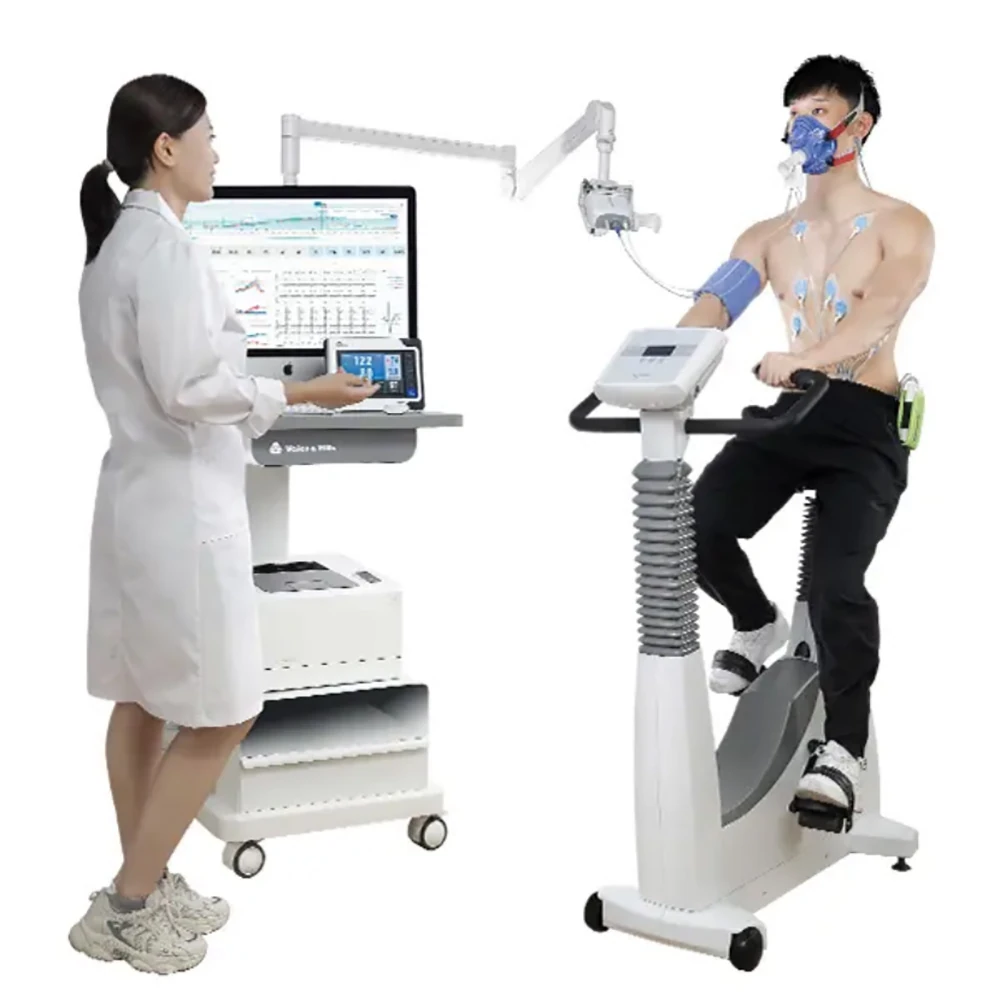
The V&H CPET system combines these functions within an all-in-one design. Its software runs on Apple macOS and uses a timeline-style display to present test information in a single interface.
The system is designed to support both resting pulmonary function testing and cardiopulmonary exercise testing, allowing these two parts of the assessment to be handled within the same overall system.
How Does a CPET Test Work?
A CPET Test generally includes two main components: resting pulmonary function testing and cardiopulmonary exercise testing.
Resting Pulmonary Function Testing
Before exercise, the patient performs supervised breathing maneuvers through a spirometer. This part of the assessment is used to obtain baseline respiratory parameters.
Depending on the testing protocol, pulmonary function measurements can include parameters such as FVC, MVV, and SVC. Integrating spirometry into the CPET system provides a starting point for understanding the patient’s respiratory function before exercise.
Cardiopulmonary Exercise Testing
During the exercise portion, the patient exercises on a treadmill or bicycle ergometer while wearing a sealed face mask. The system continuously analyzes respiratory gas exchange, including oxygen consumption and carbon dioxide production.
A finger-clip pulse oximeter is also used to monitor peripheral oxygen saturation (SpO₂) during exercise and recovery.
The V&H system further integrates ECG and stress blood pressure monitoring, allowing these measurements to be collected alongside respiratory and gas exchange data.
What Does a CPET Machine Measure?
A CPET system brings together several types of measurements rather than relying on a single parameter.
Cardiovascular Parameters
ECG monitoring is integrated into the V&H system to support observation of cardiac activity during exercise. Stress blood pressure and heart rate-related exercise parameters can also form part of the overall test data.
Respiratory and Gas Exchange Parameters
The system supports respiratory gas analysis for oxygen consumption (VO₂) and carbon dioxide production (VCO₂). Other CPET-related parameters include respiratory exchange ratio (RER) and breathing reserve.
Pulmonary function measurements such as FVC, MVV, and SVC can also be obtained through the spirometry component.
By combining these measurements, the system provides multiple types of information for reviewing cardiopulmonary responses during an exercise test.
Key Features of the V&H CPET Machine
The V&H Portable/Wearable CPET is designed around an all-in-one workflow that combines testing, monitoring, and data presentation.
All-in-One CPET Design with Apple macOS
The system is based on Apple macOS and follows an all-in-one design concept. Its CPET software uses a timeline-style interface to display information within a single frame.
The display is designed to present changes in ECG information, including subtle ST-segment variations, while keeping different test parameters within the same overall interface.
Integrated ECG, SpO₂, Gas Analysis, and Stress Blood Pressure
The system integrates ECG, O₂/CO₂ analysis, SpO₂, and stress blood pressure. This reduces the need to treat each measurement as a separate part of the testing workflow.
For CPET testing, the combination of cardiovascular, respiratory, and gas exchange information is particularly important because exercise responses involve several physiological systems at the same time.
Integrated Spirometry and Metabolic Gas Analysis
The V&H system incorporates pulmonary function testing with exercise gas analysis. Spirometry provides baseline respiratory measurements, while gas analysis during exercise measures oxygen consumption and carbon dioxide production.
This combination makes the system relevant to facilities looking for integrated pulmonary and exercise testing rather than a standalone spirometry device.
The gas-analysis function is also related to the role commonly associated with a Metabolic Cart / Gas Analyzer in CPET testing, where respiratory gases are measured during exercise.
Portable and Wireless CPET Configuration
The system is designed as a portable device and uses Bluetooth connectivity. This configuration supports different testing environments rather than limiting the system to a single fixed location.
The portability of the system also supports its use across clinical, rehabilitation, laboratory, ward, sports, and home settings, including indoor and outdoor environments.
CPET Interpretation and Data Analysis
Collecting measurements is only one part of CPET. The way test data is displayed and interpreted is also important.
The V&H system integrates functions including ERGO-ER, WASSERMAN-9, AT, INTRABREATH, QT CALE, RESP-DIVER, CALORIMETRY, WORK-LOAD, and DATA-LIST.
Wasserman Nine-Panel Plot
The Wasserman nine-panel approach provides a structured way to review multiple CPET parameters together. Within the V&H system, the WASSERMAN-9 function forms part of the available CPET analysis functions.
V-Slope Method and Exercise Parameters
The V-slope method is another approach used in CPET data analysis. The system also includes exercise-related functions for reviewing parameters generated during testing.
Measurements such as VO₂, VCO₂, RER, maximum heart rate, and breathing reserve can be considered as part of the overall CPET data set.
CPET Graphs and Data Lists
The system includes CPET graph and data-list functions for reviewing test information. Presenting data graphically can help organize measurements collected throughout an exercise protocol and make changes during the test easier to review.
Applications of the V&H CPET Machine
The portable design and integrated functions allow the V&H CPET system to support different testing environments.
Clinical and Hospital Use
In clinical and hospital settings, the system can combine ECG, gas analysis, SpO₂, stress blood pressure, and pulmonary function testing within one CPET workflow.
Its portable configuration also makes it suitable for ward-based testing where a fixed testing environment may not always be practical.
Rehabilitation and Sports Testing
CPET can be used in rehabilitation and sports-related testing environments where exercise responses need to be monitored alongside respiratory and cardiovascular parameters.
The integrated design allows relevant measurements to be collected during exercise while maintaining a single testing system.
Laboratory and Research Applications
The combination of pulmonary function testing, exercise testing, gas analysis, and data-analysis functions makes the system suitable for laboratory environments that require multiple types of cardiopulmonary measurements.
Its portable configuration can also provide flexibility when testing locations or experimental setups vary.
Ward and Home-Based Testing
The V&H CPET system is designed for use across a range of environments, including wards and home settings. Its portable form and Bluetooth connectivity support applications beyond a traditional fixed laboratory setup.
The system can therefore be considered when flexibility of location is an important part of the testing workflow.
Conclusion
A modern CPET Machine needs to bring together more than exercise testing alone. Pulmonary function, gas exchange, ECG, SpO₂, stress blood pressure, and data analysis can all contribute to a broader CPET workflow.
The V&H CPET system combines these functions in an all-in-one design based on Apple macOS, with Bluetooth connectivity and a portable configuration. It supports resting pulmonary function testing, cardiopulmonary exercise testing, gas analysis, CPET interpretation, and data review across clinical, rehabilitation, laboratory, ward, sports, and home settings.
For organizations looking for an integrated approach to cardiopulmonary exercise testing, the V&H system provides a single platform for bringing these testing functions together. Contact V&H to learn more about the CPET system, its features, and applications.
Frequently Asked Questions
What is a CPET Machine used for?
A CPET Machine is used to assess cardiopulmonary responses during exercise by combining exercise testing with cardiovascular, respiratory, and gas exchange measurements. It can be used in clinical, rehabilitation, sports, and research settings.
What does a CPET Test measure?
A CPET Test can measure parameters such as oxygen consumption (VO₂), carbon dioxide production (VCO₂), respiratory exchange ratio (RER), breathing reserve, heart rate, ECG, SpO₂, and stress blood pressure. Pulmonary function measurements such as FVC, MVV, and SVC can also be included.
What is CPET Interpretation?
CPET Interpretation involves reviewing the data collected during exercise to understand changes in cardiovascular, respiratory, and gas exchange responses. Tools such as the Wasserman nine-panel plot and V-slope method can help organize and analyze CPET data.
Post time: September 18, 2026


