


Choosing a Holter ECG monitoring system requires more than looking at the basic specifications of an ECG recorder. For hospitals, clinics, diagnostic centers, and medical equipment distributors, the right system should match the intended monitoring period, ECG recording requirements, data analysis needs, and reporting workflow.
Unlike a conventional resting ECG examination, Holter monitoring is designed to record ECG activity over an extended period. As a result, factors such as recording channels, memory capacity, sampling rate, software analysis, data transfer, and recorder design all need to be considered together.
This guide outlines the main factors B2B buyers should evaluate when selecting a Holter ECG monitoring system.
1. Consider the ECG Recording Configuration
The first factor to evaluate is the ECG recording configuration. Different monitoring requirements may call for different numbers of channels or leads.
When comparing an Ecg Holter Recorder, buyers should check the supported recording configuration and patient cable options. A system may be designed for 3-channel recording, multi-lead recording, or other configurations depending on its intended application.
Important specifications to review include:
- Number of ECG channels or leads
- Patient cable configuration
- Recording mode
- Full-disclosure recording
- Signal verification
- Pacemaker detection
The recording configuration should be selected according to the intended monitoring requirements rather than simply choosing the highest number of channels available.
2. Evaluate Recording Duration and Memory
Recording duration is another important consideration. Holter monitoring can involve continuous ECG recording for one or several days, so the recorder needs sufficient storage capacity for the intended monitoring period.
When evaluating a system, buyers should consider:
- Supported recording duration
- Memory type and capacity
- Data storage method
- Data download interface
- Compatibility with the analysis workflow
A 24 Hour Ecg Holter Monitor may be appropriate for applications requiring one day of continuous monitoring, while longer recording capability can provide additional flexibility when extended monitoring is required.
The storage system should also be considered together with data transfer. SD card or USB-based transfer, for example, can affect how recorded ECG data is moved to the analysis workstation.
3. Check Sampling Rate and Resolution
Sampling rate and resolution are important technical specifications when comparing digital ECG recording systems.
The sampling rate indicates how frequently the ECG signal is sampled during digital recording, while resolution describes the number of digital levels used to represent the signal.
When comparing systems, buyers should review:
- Sampling rate
- Resolution
- Frequency response
- Signal verification
- Recording mode
These specifications should be considered together rather than evaluated individually. A clear comparison of the technical parameters can help procurement teams distinguish between different recording systems.
4. Consider Holter Monitor Software and Analysis Functions
The recorder is only one component of a complete Holter monitoring workflow. The analysis software is equally important because long-term monitoring can generate a large amount of ECG data that needs to be reviewed and organized.
When evaluating Holter Monitor Software, buyers should consider whether it supports the analysis functions required by the intended users.
Common areas to evaluate include:
- Arrhythmia analysis
- Heart rate analysis
- ST analysis
- QT/QTc analysis
- Pause detection
- Atrial fibrillation or flutter analysis
- Heart rate variability
- Pacemaker analysis
- Full-disclosure review
- Report generation
A system with a broader range of analysis functions may provide greater flexibility, but the final selection should still be based on actual clinical and operational requirements.
5. Review Data Editing and Reporting Capabilities
Long-term ECG monitoring is not only about recording data. The recorded information also needs to be reviewed, edited, organized, and presented in a usable report.
For this reason, buyers should examine whether the software supports multi-day data editing, event review, report customization, printing, and digital output.
Useful functions may include:
- Full-disclosure ECG review
- Event verification
- Multi-day recording editing
- Customized report formats
- PDF output
- Print preview
- Color printing
- Email functions
For hospitals and diagnostic centers, these capabilities can influence how efficiently ECG information moves from recording to final report.
6. Consider Advanced Analysis Requirements
Different organizations may have different requirements for ECG analysis. Some applications may focus on basic rhythm analysis, while others may require more specialized functions.
When selecting a system, buyers can check whether it supports functions such as:
- QT/QTc analysis
- Atrial fibrillation/flutter detection
- Heart rate variability
- Late potentials SAECG
- VectorCardioGraphy
- Pacemaker recording analysis
- Sleep apnea monitoring
- T-wave alternans analysis
- Standard resting 12-lead analysis
The goal is not necessarily to choose the system with the longest feature list. Instead, buyers should identify which functions are relevant to their intended workflow and then compare systems accordingly.
7. Look at Recorder Size and Portability
The physical design of the recorder can also be important, especially when ECG data is recorded continuously for an extended period.
For a portable ECG recording device, buyers may want to compare:
- Overall dimensions
- Weight
- Enclosure material
- Operating orientation
- Connector design
- Patient cable configuration
- Gain settings
A smaller and lighter recorder can be easier to handle during extended monitoring, but physical size should always be evaluated together with recording performance and required functions.
8. Check Software Language and Computer Compatibility
Software compatibility is another practical consideration for hospitals, clinics, distributors, and international medical equipment suppliers.
Before purchasing a Holter system, buyers should check:
- Available software languages
- Supported operating systems
- Data export options
- Report formats
- Computer requirements
These details can help ensure that the monitoring system fits the organization’s existing technical environment and workflow.
9. Consider the Complete Holter Monitoring Workflow
A Holter ECG monitoring system should be evaluated as a complete solution rather than as a recorder alone.
A practical comparison can include five main areas:
| Evaluation Area | Key Factors to Consider |
| ECG Recording | Channels, leads, sampling rate, resolution |
| Data Storage | Recording duration, memory, SD card, USB transfer |
| Analysis | Arrhythmia, ST, QT/QTc, HRV, AF/flutter, pacemaker analysis |
| Reporting | Data editing, customized reports, PDF output, printing |
| Recorder Design | Dimensions, weight, cables, connectors, gain settings |
This approach allows procurement teams to compare systems according to actual operational requirements instead of focusing on a single specification.
Vales and Hills Holter ECG Monitoring System
Based on these selection criteria, the V&H Holter ECG Monitoring System brings together flexible recording configurations, extended recording time, and comprehensive analysis functions in one system. V&H offers a Holter ECG system designed for both 3-channel and 12-lead ECG recording and analysis. The system combines a compact Holter recorder with dedicated analysis software for long-term ECG monitoring.
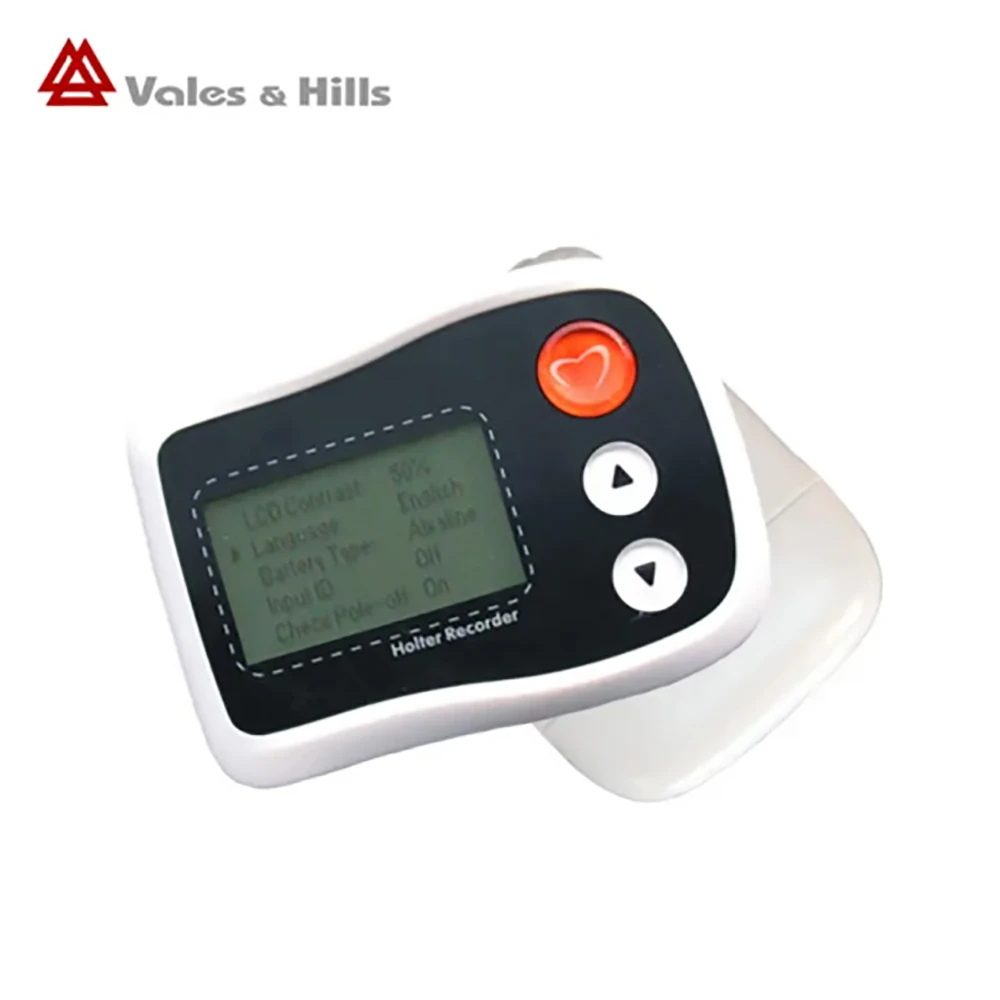
The recorder supports 24–72 hours of recording and uses SD card storage with a 2GB capacity. Recorded data can be downloaded through an SD card reader or USB connection.
In terms of recording specifications, the system provides a maximum sampling rate of 1024 samples per second, 8–16 bit resolution, and a frequency response of 0.05 Hz to 60 Hz. It also provides LCD-based signal verification and supports pacemaker detection.
Compact Recorder Design
The recorder measures 72 × 53 × 16 mm and weighs 62 g with battery. It uses an ABS plastic enclosure and can operate in any orientation.
The recorder provides 0.5X, 1X, and 2X gain settings, a 19-pin connector, and supports 10-lead or 5-lead patient cables.
Holter Analysis Software
The V&H Holter software integrates ECG analysis, data review, and reporting functions in one system. Key functions include:
| Software Function | Details |
| Arrhythmia Analysis | VE, SVE, bigeminy, trigeminy, pairs, runs, V-Tach, minimum and maximum heart rate, ST, pauses, QT/QTc, and bundle branch blocks |
| Atrial Fibrillation & Flutter | Atrial fibrillation/flutter detection and editing |
| Heart Rate Variability | Time-domain and spectral heart rate variability analysis |
| QT/QTc Analysis | QT/QTc analysis validation program |
| Pacemaker Analysis | Analysis of pacemaker recordings |
| Sleep Apnea Monitoring | Detection of SAS episodes |
| Advanced ECG Analysis | Late Potentials SAECG, VectorCardioGraphy, and T-Wave Alternans analysis |
| Full-Disclosure Review | 24-hour full-disclosure scanning with color-coded events for visual verification |
| ECG Histograms | 24-hour histograms of HR, ST, QT/QTc, VE, SVE, pauses, and SDNN |
| Multi-Day Data Editing | Multi-day recordings can be edited into one editing file, with the option to print one report for all days or one report per day |
| Report & Output | Customized report formats, custom conclusion formats, header logo, PDF output, email, color printing, and print preview |
| Languages | Chinese, Turkish, English, French, Japanese, and Spanish |
| Operating Systems | Windows XP, Vista, Windows 7, Windows 8, and Windows 10 |
Conclusion
Selecting a Holter ECG monitoring system requires a balanced evaluation of recording capabilities, storage, technical specifications, software analysis, reporting functions, and recorder design.
For B2B buyers, the most important consideration is whether the system can meet the organization’s actual monitoring and workflow requirements. Factors such as ECG configuration, recording duration, software capabilities, data management, and portability should therefore be evaluated together.
A system such as the V&H Holter ECG solution combines 3-channel and 12-lead recording, 24–72-hour recording capability, a compact recorder, and dedicated ECG analysis software, providing a range of functions for organizations evaluating long-term Ambulatory Ecg Monitoring applications. For more information about the V&H Holter ECG Monitoring System or to discuss your specific requirements, please contact the V&H team.
FAQ
1. What recording duration should a Holter ECG system support?
The required recording duration depends on the monitoring application. A Holter system may support 24-hour or longer recording periods. The V&H system supports 24–72 hours of recording.
2. What should I look for in Holter ECG analysis software?
Key functions to consider include arrhythmia analysis, ST and QT/QTc analysis, atrial fibrillation/flutter detection, heart rate variability, pacemaker analysis, full-disclosure review, and report generation.
3. What is the difference between a 3-channel and 12-lead Holter system?
The main difference is the ECG recording configuration. The appropriate option depends on the intended monitoring requirements. The V&H system supports both 3-channel and 12-lead ECG recording and analysis.
Post time: August 21, 2026


