


Choosing a stress test ECG system is an important decision for hospitals, cardiology clinics, rehabilitation centers, and medical equipment distributors. The right system should provide reliable ECG acquisition during exercise while also supporting practical monitoring, analysis, and reporting.
However, comparing systems only by price or the number of listed features can make the purchasing process more complicated. Different systems may vary in ECG acquisition technology, signal filtering, testing protocols, software functions, and reporting capabilities.
For B2B buyers, a better approach is to first understand what the stress testing workflow requires, then evaluate the technical specifications and software functions that support that workflow. The manufacturer’s experience and ability to provide technical information should also be considered before making a purchasing decision.
What Is a Stress Test ECG System?
A stress test ECG system is designed to record and analyze ECG signals while a patient performs controlled physical exercise. Unlike resting ECG testing, stress testing requires continuous ECG monitoring while the patient is exercising.
The test can be performed using equipment such as a treadmill or bike ergometer. During the procedure, healthcare professionals may need to monitor ECG signals together with parameters such as heart rate and blood pressure.
Because the patient is moving during the test, the system needs to maintain stable ECG acquisition while dealing with signals that may be caused by muscle activity or movement.
Therefore, when evaluating a stress test ECG system, buyers should look beyond basic ECG recording. Signal quality, filtering, real-time monitoring, testing protocols, analysis, and reporting should all be considered as part of the overall system.
How Important Is 12-Channel ECG Acquisition in Stress Testing?
A 12-channel ECG machine allows multiple ECG channels to be acquired simultaneously during an exercise stress test. This gives healthcare professionals access to ECG information from different leads throughout the testing process.
For buyers, the important point is not simply whether a system has 12 channels. The acquisition technology and the way the system handles ECG signals during exercise are also important.
ECG Acquisition and Signal Quality
ECG acquisition quality is one of the first technical areas that should be evaluated. A stress test system should continuously acquire ECG data and display the signals clearly during the test.
Buyers can compare factors such as A/D resolution, sampling capability, acquisition technology, and signal processing.
These specifications provide a better basis for comparing systems than simply looking at the number of features listed on a product page.
Filtering During Exercise
Physical activity can introduce unwanted signals into an ECG recording. Muscle activity and changes in the baseline can also affect the displayed waveform.
For this reason, filtering technology is particularly important in stress testing.
When comparing systems, buyers should understand what technologies are available for handling muscle-related interference, baseline wander, and other artifacts.
The purpose is not simply to choose the system with the largest number of filters. More importantly, buyers should determine whether the available filtering functions are appropriate for the intended stress testing environment.
Treadmill and Bike-Ergometer Testing
The ECG system should also match the exercise equipment used by the healthcare facility.
Buyers should confirm whether the system supports treadmill testing, bike-ergometer testing, or both. It is also useful to check whether the system provides preset testing protocols and whether users can define their own protocols.
For facilities using exercise testing as part of rehabilitation, rehabilitation-related functions may also be considered during the purchasing process.
What ECG Analysis Features Should a Stress Test System Provide?
ECG analysis is another important part of a stress testing system. The system should provide users with practical tools for reviewing ECG information and changes during the test.
ST Segment Information
ST segment information can be an important part of exercise ECG analysis. When comparing systems, buyers should check whether the software provides relevant parameters for reviewing ECG changes during testing.
The way this information is displayed and organized can also affect how efficiently healthcare professionals can review the test.
Arrhythmia Detection and Live Review
Stress testing requires ECG information to be monitored throughout the procedure rather than only reviewed after the test has finished.
Therefore, buyers should consider whether the system provides arrhythmia detection and live ECG review.
These functions allow users to follow ECG information during the test and review relevant events as the procedure progresses.
Heart Rate and Blood Pressure
Stress testing may involve several physiological parameters. Being able to view relevant information together can provide a more complete picture of the testing process.
When comparing systems, buyers should check which parameters can be displayed and whether they can be viewed synchronously during testing.
Why Does Reporting Matter in a Stress Test ECG System?
A stress test ECG system should not only display ECG waveforms during testing. The ability to review and organize test information after and during the procedure is also important.
Stress Test Reports
Exercise testing can generate ECG and exercise-related information throughout the procedure. Reporting functions help organize this information so that it can be reviewed after testing.
Before purchasing a system, buyers should check which parameters can be included in reports and whether the reporting functions fit their existing workflow.
Trend Tracking and Comparison
Trend functions allow users to review changes throughout the stress test instead of relying on information from a single point in time.
When comparing systems, buyers should check whether the software provides trend tracking, comparison, and other tools for reviewing changes during testing.
Reviewing Data During and After Testing
Live review can be useful during the procedure, while stored information and reports are important after the test.
Therefore, buyers should evaluate whether the system provides suitable functions for reviewing ECG information both during and after exercise testing.
What Technical Specifications Should You Compare?
Before purchasing a stress test ECG system, buyers should compare technical specifications that directly affect ECG acquisition, signal quality, and daily operation.
ECG System Technical Specifications & Evaluation Checklist
| Technical Specification | What Buyers Should Evaluate |
| A/D Resolution | The resolution used for ECG data acquisition |
| Sampling Rate | The sampling capability of each ECG channel |
| ECG Acquisition | Whether synchronized digital acquisition is supported |
| Myoelectric Filtering | How muscle-related ECG interference is handled |
| Baseline Wander Removal | How baseline changes are managed during exercise |
| Selectable Filters | Whether LP, HP, and artifact filters are available |
| Electrode Measurement | Whether skin-electrode impedance can be measured |
| Testing Protocols | Whether preset and user-defined protocols are supported |
| Analysis Functions | Which ECG and exercise-related parameters can be reviewed |
| Reporting | Whether suitable stress test reports can be generated |
These specifications should be evaluated together rather than individually. A system may have strong specifications in one area but still not be suitable for a particular testing workflow.
For B2B procurement, buyers should also request complete technical documentation and confirm that the specifications meet the requirements of the intended application and target market.
What Does a Well-Designed Stress Test ECG System Look Like?
A well-designed stress test ECG system should bring ECG acquisition, signal filtering, testing protocols, real-time monitoring, analysis, and reporting together in one workflow.
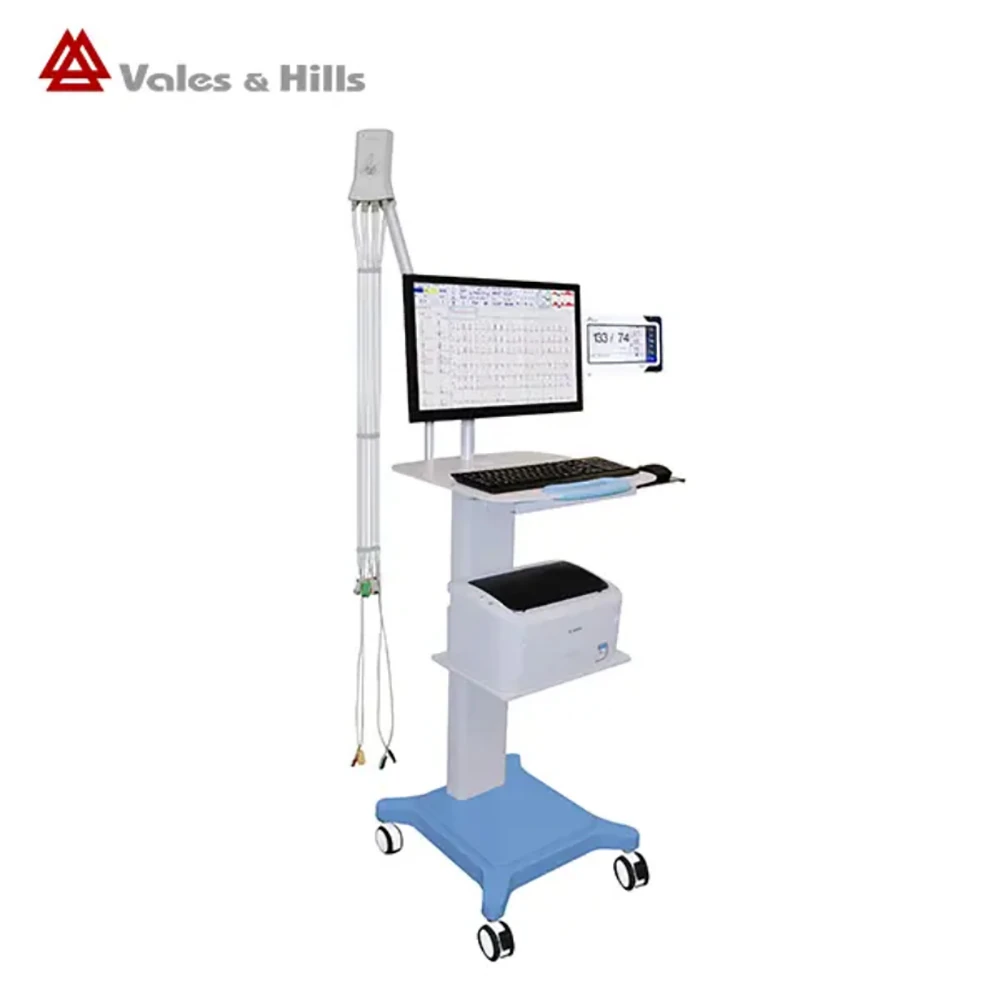
The V&H CV1200 is a PC-based stress test ECG system designed for treadmill and bike-ergometer testing.
The CV1200 uses a high-resolution A/D system with 24K SPS/Ch and 24 bits. It also uses digital synchronous A/D technology for ECG data acquisition.
For signal processing, the system provides a myoelectric filter based on the ECG spectrum and a proprietary minimum-delay baseline wander eraser. Different filters, including LP, HP, and artifact filters, can also be selected.
The system provides skin-electrode impedance measurement and supports preset classical protocols as well as unlimited user-defined protocols.
For stress test analysis, the CV1200 provides arrhythmia detection and live review. It also provides various trend functions for tracking and comparison.
During testing, the system can synchronously display ECG, BP, SpO₂, METS, max VO₂, Distance, and Time.
For rehabilitation applications, the system provides a rehabilitation mode with cardiac function recovery protocols.
How to Evaluate the Stress Test ECG System Manufacturer
After identifying the technical requirements, buyers should evaluate the manufacturer as the next step.
For B2B procurement, the manufacturer is an important part of the purchasing decision. Product quality, technical communication, documentation, and ongoing support can all affect the overall purchasing experience.
Manufacturer Experience
Vales and Hills Biomedical Tech. Ltd. (V&H) was established in 2004 and has more than 20 years of experience in Portable ECG and Telemedicine technology.
The company is located at BDA International Park in Beijing and operates as a manufacturer, importer, exporter, and seller.
This information can provide buyers with a reference when evaluating the manufacturer’s experience in ECG and medical technology.
Product Portfolio
V&H develops the CardioView product line, covering several ECG applications.
Its product range includes PC-based resting ECG devices, wireless ECG devices, stress ECG machines, and Holter ECG devices. The company also provides ECG cloud and network services, ECG simulators, and ECG accessories.
For B2B buyers, a broader ECG product portfolio can be one reference when evaluating a manufacturer’s experience across different ECG applications.
International Market Experience
V&H’s ECG devices have been sold in European, North American, South American, Southeast and Eastern Asian, Australian, African, Oceanian, and Middle Eastern markets.
The company has also participated in international professional exhibitions, including ACC, ESC, and MEDICA.
For international distributors and medical equipment buyers, experience in different markets can be considered when comparing potential suppliers.
Stress ECG Machine Purchasing Checklist
Before placing an order, buyers can review the following points:
- Does the system support the required treadmill or bike-ergometer application?
- Does it provide suitable multi-channel ECG acquisition?
- What A/D resolution and sampling specifications are provided?
- What filtering technologies are available for exercise-related interference?
- Does the system provide arrhythmia detection and live ECG review?
- Can users create or modify stress test protocols?
- What parameters can be displayed and analyzed?
- Does the software provide trend tracking and comparison?
- Can the system generate appropriate stress test reports?
- Does the manufacturer have relevant ECG development experience?
- Does the manufacturer have experience serving international markets?
- Are the required product certifications and technical documents available for the target market?
- Can the supplier provide suitable technical and after-sales support?
This checklist allows buyers to compare different suppliers using consistent criteria rather than focusing on price alone.
Conclusion: Choosing the Right Stress Test ECG System
Choosing a stress test ECG system should be based on the complete application rather than a single specification or the lowest purchase price.
A reliable evaluation should cover ECG acquisition quality, filtering technology, stress test protocols, analysis functions, reporting capabilities, manufacturer experience, and technical support.
For hospitals, clinics, rehabilitation facilities, and medical equipment distributors, comparing these factors before purchasing can make it easier to identify a system that fits the intended stress testing workflow.
The V&H CV1200 combines PC-based stress ECG software with a dedicated acquisition device and provides treadmill and bike-ergometer support, filtering functions, flexible protocols, real-time monitoring, trend analysis, and reporting functions.
For organizations evaluating professional stress test ECG solutions, these technical and manufacturer-related factors can provide a practical framework for comparing available systems before making a purchasing decision. If you are evaluating a stress test ECG system for your hospital, clinic, rehabilitation center, or distribution business, contact V&H to discuss your application requirements and find a suitable solution for your market.
FAQ
1. What is a stress test ECG system used for?
A stress test ECG system records and analyzes ECG signals while a patient performs controlled exercise, such as treadmill or bike-ergometer testing.
2. What should buyers consider when choosing a stress test ECG system?
Buyers should consider ECG acquisition quality, filtering technology, testing protocols, analysis and reporting functions, as well as the manufacturer’s experience and technical support.
3. Why does a stress test ECG system need filtering functions?
Exercise can introduce muscle activity, baseline wander, and other interference into ECG recordings. Filtering functions help manage these types of interference and support more stable ECG signal acquisition during stress testing.
Post time: August 26, 2026


