


Introduction
Heart rhythm can change throughout the day. Some irregularities occur during physical activity, rest, sleep, or other daily situations, making them difficult to capture during a short ECG examination. This is why Ambulatory ECG Monitoring plays an important role in observing cardiac electrical activity over an extended period.
However, collecting ECG data over many hours does not automatically guarantee a clear and useful recording. Signal quality depends on several factors, including the recording system, electrode contact, lead configuration, patient movement, and data processing.
For healthcare providers, distributors, and medical equipment buyers, understanding these factors helps when evaluating a Holter ECG system and its suitability for different monitoring needs. This article explains the main elements that influence Holter ECG recording quality and introduces the relevant features of V&H’s Holter ECG system.
1. ECG Sampling Rate and Signal Resolution
The sampling rate determines how frequently an ECG device measures the electrical signal. It is usually expressed in samples per second (SPS). A higher sampling rate captures more points within a given period, allowing the system to represent changes in the ECG waveform in greater detail.
This is particularly relevant when analyzing waveform features that occur over short periods. If the sampling rate is insufficient for the signal being measured, some details may be lost during digital recording.
Signal resolution is another important factor. It describes how precisely the system converts the measured electrical signal into digital values. Resolution is commonly expressed in bits. Higher bit resolution allows more digital levels to represent signal amplitude, which can help preserve smaller differences in the recorded waveform.
When evaluating an ECG Holter Recorder, buyers should consider both sampling rate and resolution rather than looking at either specification alone. The recording system also needs an appropriate frequency response and signal acquisition design to capture the ECG signal within its intended range.
2. Electrode Placement and Skin Contact
Electrodes provide the connection between the patient’s body and the ECG recording system. Their placement and contact with the skin directly affect the signals collected during monitoring.
Poor skin contact can increase electrical resistance and introduce noise into the recording. Loose electrodes, dried conductive gel, sweat, and movement can also cause intermittent signals or baseline fluctuations.
Correct electrode placement is equally important. Each electrode needs to be positioned according to the intended monitoring configuration. Incorrect placement may change the recorded waveform and make comparisons or interpretation more difficult.
For reliable recording, healthcare staff generally need to check that:
- The skin is clean and dry before electrode application.
- Electrodes are attached securely and maintain consistent skin contact.
- Lead wires are connected correctly.
- Electrode positions follow the selected recording configuration.
These practical steps are important throughout Ambulatory ECG Monitoring, especially when patients continue their normal daily activities during a multi-hour recording.
3. Lead Configuration and Signal Acquisition
Lead configuration determines how electrical activity from the heart is observed. Different configurations provide different views of cardiac electrical signals, so the appropriate setup depends on the monitoring purpose and clinical requirements.
For example, 3 Lead ECG Monitoring is commonly discussed in the context of basic multi-lead observation, while more extensive configurations can provide additional views of cardiac electrical activity. The number of leads and the number of recording channels are related technical terms, but they are not interchangeable. Buyers should check the actual system configuration instead of assuming that a three-channel system is identical to a three-lead system.
The patient cable is also part of the signal acquisition process. Its lead count and connector compatibility must match the recording setup. Incorrect connections, damaged cables, or poor cable management can interrupt signal transmission or introduce noise.
When selecting a Holter system, healthcare providers and distributors should therefore consider the intended lead configuration, patient cable options, and compatibility between the recorder and its accessories.
4. Patient Movement and Motion Artifacts
Unlike a short resting ECG examination, Holter monitoring records cardiac activity while patients go about their daily routines. Walking, working, exercising, changing posture, and sleeping can all affect the quality of the collected signals.
Movement may cause electrodes to shift against the skin or lead wires to pull on their connections. These changes can produce motion artifacts, which appear as unwanted variations in the ECG waveform.
Some artifacts may resemble changes in cardiac activity, making it harder to distinguish actual events from recording interference. This is why a continuous recording needs to be reviewed in context rather than interpreted solely by looking at isolated waveform segments.
Several practical measures can help reduce movement-related interference:
- Secure electrodes firmly before monitoring begins.
- Arrange lead wires to reduce pulling and unnecessary movement.
- Use suitable electrode placement for the intended monitoring period.
- Check the signal at the beginning of the recording.
- Review questionable segments during data analysis.
A stable connection between the patient, electrodes, cables, and recorder is essential for maintaining consistent signal acquisition.
5. Holter Monitor Software and Data Processing
Recording is only one part of Holter monitoring. After data collection, software is used to organize, display, and analyze the recorded ECG information.
Holter Monitor Software can help users review long-duration recordings by identifying and organizing events of interest. Depending on the software, analysis functions may include heart rate trends, arrhythmia events, ST changes, pauses, QT/QTc measurements, and heart rate variability.
Full-disclosure review is also useful because it allows users to examine the recorded ECG data over time rather than relying only on automatically selected events. Visual markers, histograms, and editable analysis results can help technicians locate relevant sections more efficiently.
However, automated analysis should not be treated as a substitute for professional review. Signal artifacts, electrode problems, and unusual waveform patterns may affect automated results. The quality of the original recording remains important even when advanced analysis tools are available.
For medical facilities and distributors, software compatibility, report customization, data transfer, and the range of supported analysis functions are practical considerations when comparing Holter systems.
6. V&H Holter ECG System: Recording and Analysis Features
Reliable Holter ECG monitoring requires a recording system that can maintain stable data acquisition over extended periods while supporting efficient data review and analysis. From recording configuration and sampling performance to data storage and software functions, each feature contributes to the overall monitoring workflow. A well-designed system brings these capabilities together to meet different monitoring requirements.
V&H’s Holter ECG system combines flexible recording configurations, high-speed sampling, long-duration recording, and comprehensive software analysis functions. With both 3-channel and 12-lead recording options, up to 1,024 samples per second, and 24–72 hours of recording time, the system provides practical support for long-term ECG monitoring. Its accompanying software further supports the review of arrhythmias, ST changes, QT/QTc, heart rate variability, and other ECG events.
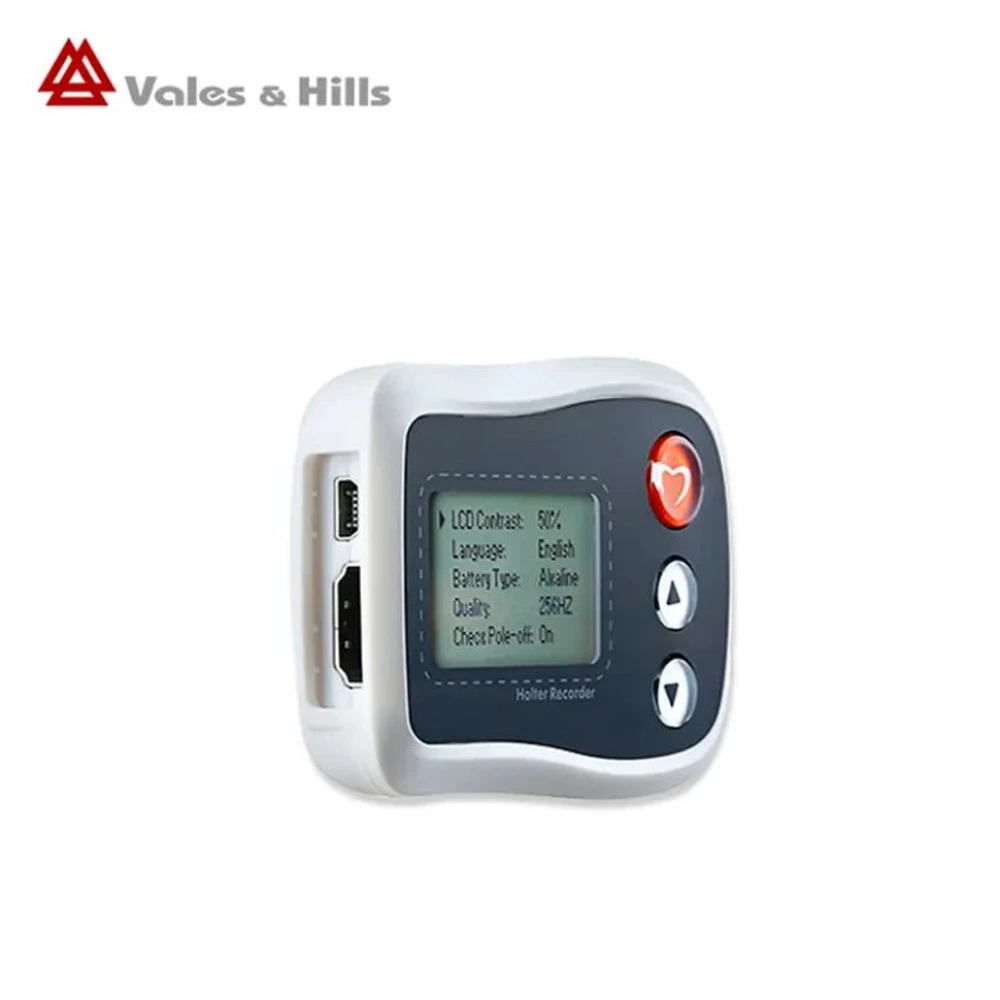
Recording Configuration and Signal Specifications
The system supports 3-channel and 12-lead recording configurations. The recorder specifications include 8–16-bit resolution and a maximum sampling rate of 1,024 samples per second. Its frequency response is listed as 0.05 Hz to 60 Hz.
For signal verification, the recorder features an LCD display. It also supports pacemaker detection and full-disclosure recording.
Recording Duration and Data Transfer
The recorder supports 24–72 hours of recording, with data stored on a 2GB SD card. Recorded data can be transferred through an SD card reader or USB connection.
The device measures 72 × 53 × 16 mm and weighs 62 g with the battery. Its enclosure is made of ABS plastic, and it can operate in any orientation.
Patient Cable and ECG Accessories
The recorder supports 5-lead and 10-lead patient cables. These options allow the system to be configured for different recording setups.
When evaluating ECG Accessories, buyers should pay attention to cable compatibility and the connection requirements of the recorder. The electrode and cable setup needs to match the intended monitoring configuration to support consistent signal acquisition.
Software Analysis Functions
V&H’s Holter software supports analysis of several ECG parameters and events, including ventricular and supraventricular ectopic activity, bigeminy, trigeminy, pairs, runs, minimum and maximum heart rate, ST changes, pauses, and QT/QTc.
Additional functions include:
- Atrial fibrillation and flutter detection and editing
- Time-domain and spectral heart rate variability analysis
- Full-disclosure ECG scanning with color-coded events
- Histograms for heart rate, ST, QT/QTc, ectopic events, pauses, and SDNN
- Pacemaker recording analysis
- Customizable reports with options for PDF output and email
The software supports multiple languages, including Chinese, Turkish, English, French, Japanese, and Spanish. These functions help technicians review recorded data and prepare reports according to their workflow.
Conclusion
Holter ECG recording quality depends on the entire monitoring process. Sampling rate and resolution influence how signals are digitized, while electrode contact, lead configuration, and patient movement affect the signals collected from the body. Software then supports the review and analysis of the recorded data.
For healthcare providers and medical equipment distributors, evaluating these factors together offers a more practical way to compare Holter ECG systems. V&H’s Holter ECG system combines 3-channel and 12-lead recording options, multi-hour recording, SD card or USB data transfer, and a range of software analysis functions.
Contact our team to learn more about V&H Holter ECG systems, recording configurations, and software capabilities for your application.
Frequently Asked Questions
1. What factors have the greatest impact on Holter ECG recording quality?
Electrode contact, correct lead placement, sampling rate, patient movement, and signal processing all affect Holter ECG recording quality. Each factor contributes to the accuracy and consistency of the recorded data.
2. What is the difference between 3-channel and 12-lead Holter ECG monitoring?
A 3-channel system records ECG signals through three channels, while a 12-lead configuration provides twelve views of the heart’s electrical activity. Channel count and lead count describe different aspects of the recording system.
3. How long can a Holter ECG monitor record continuously?
Recording duration varies by device. V&H’s Holter ECG system supports 24–72 hours of recording, allowing ECG data to be collected over an extended monitoring period.
Post time: November 13, 2026


