


Bluetooth ECG for Android uses compatible external ECG hardware to send heart-signal data to an Android phone or tablet. The recorder captures the electrical signal; the Android application receives or manages it according to the system’s design. ECG stands for electrocardiogram, and EKG is another abbreviation for the same test.
Two products can both say “Android” and “Bluetooth” while offering very different measurements. One may record a single rhythm channel through a small sensor. Another may support a professional 12-lead examination with a patient cable and a dedicated application. Their shared connection method is only the beginning of a comparison.
If you’re evaluating equipment for a clinic, hospital, or distribution business, that difference matters before you compare prices. This guide explains the device types, the role of companion apps, and the details that make a buying decision clearer. It uses named product information where available and separates manufacturer-listed features from configuration details you still need to confirm.
Key takeaways
- Bluetooth and Android describe connectivity and platform support; they do not establish an ECG device’s examination scope.
- An Android ECG app needs the external acquisition hardware documented for that system.
- A standard 12-lead ECG uses 10 electrode connections; leads and electrodes are different concepts.
- V&H’s iCV200 Android listings name aECG and describe simultaneous 12-channel measurement and analysis.
- Compare the recorder, application, supported host, accessories, reports, and quoted services together.
For professional equipment options, explore the Bluetooth ECG for Android range from Vales and Hills Biomedical Tech. Ltd. (V&H). Use this guide to work out which questions to ask about the equipment you shortlist.
What is Bluetooth ECG for Android?
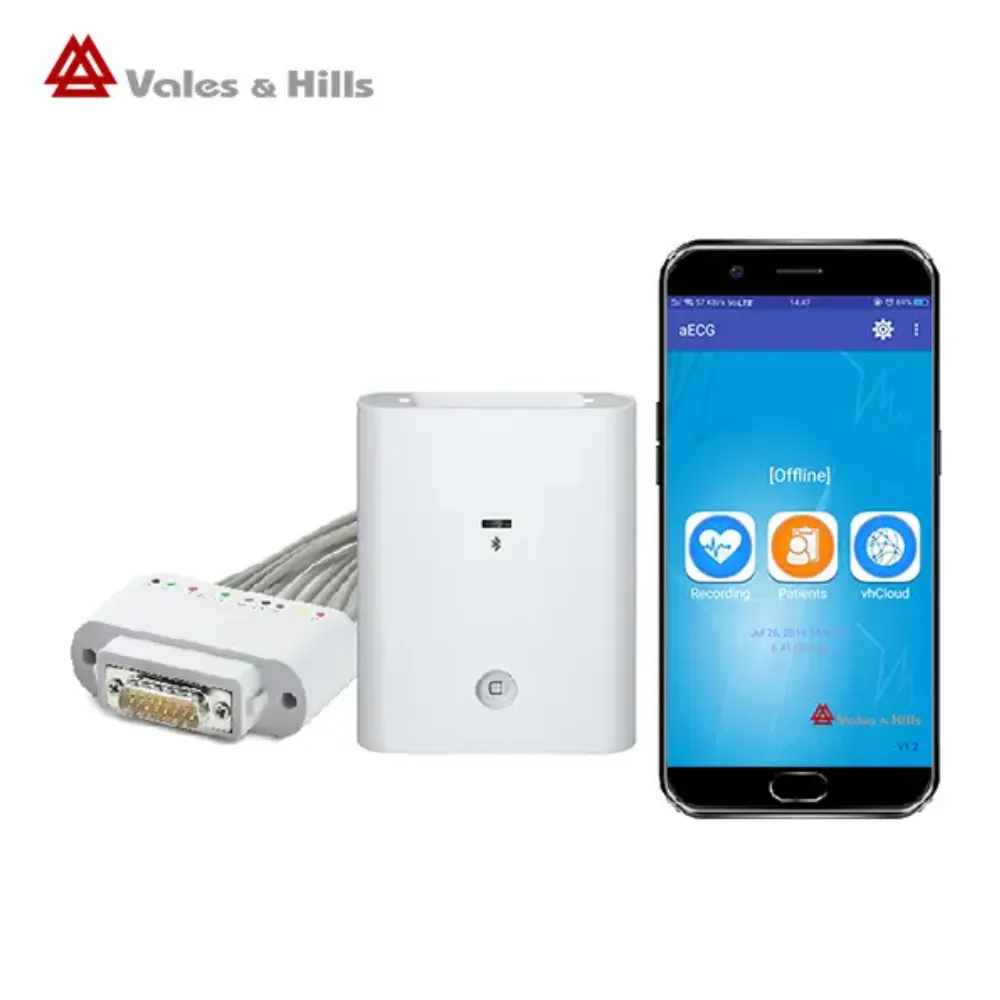
The term describes a connection between ECG acquisition hardware and a supported Android device. It does not name one universal product standard. The recorder, electrodes, application, and intended use determine what the complete system can do.
What does the Android device do?
Depending on the product, the phone or tablet may display a waveform, manage recordings, generate a report, or pass data to other software. Ask which functions run on the Android host and which require another component. A phone shown beside a recorder does not establish the location of analysis or storage.
For example, Biocom’s BC6500 description explains an Android bridge app that forwards ECG data to Windows software for heart rate variability analysis. This illustrates one architecture, not a capability shared by every Android ECG device. It also does not establish compatibility between Biocom and V&H equipment.
What does the Bluetooth link tell you?
Bluetooth identifies the data link in the documented configuration. It does not tell you the acquired lead count, supported examination, recording duration, report format, or clinical interpretation process. Those details belong in the product specification.
Also check what “wireless” means for the patient connection. V&H’s iCV200 product information includes a patient cable. In that configuration, Bluetooth carries recorder-to-host data while the cable and electrodes connect the patient to the recorder.
Don’t select equipment on a cable-free assumption. Confirm the actual components and follow the current instructions for use for setup and operation.
Compare Android ECG device types before choosing
Start by sorting products into meaningful groups. A small sensor, a handheld rhythm device, and a professional multi-lead system may all appear in the same search. Their functions need separate evaluation.
| Equipment type | What to examine in the documentation | Buying question |
|---|---|---|
| Handheld or wearable rhythm device | Acquired leads, recording conditions, intended use, and companion software | Does this configuration support the measurement your service needs? |
| Sensor and recording app | Required sensor, waveform channels, app functions, and export options | Is the app a viewer, recorder, data gateway, or part of a larger system? |
| Professional 12-lead system | Patient connections, simultaneous acquisition, analysis, review, and report functions | Does the complete configuration meet the documented examination requirements? |
These categories help organize a comparison. They do not mean every device in a group has the same capabilities or regulatory status. Check the selected model rather than treating the group label as a specification.
Read leads, channels, and recording modes separately
A lead is a view of electrical activity; an electrode is a patient contact. The Royal Papworth Hospital ECG explanation describes 10 electrodes producing 12 leads. Twelve leads therefore does not mean twelve electrodes.
A channel specification concerns signal acquisition or presentation as defined by the manufacturer. Ask whether the quoted system acquires the required signals simultaneously and which recording modes it supports. Do not infer the full examination scope from a number in a product title.
For a concrete sensor/app example, Movesense ECG Recorder identifies its separately required Movesense MD sensor and describes a single-channel waveform. That is useful product clarity. It is not evidence that a single-channel setup and a standard 12-lead configuration provide the same examination.
Illustrative scenario: Taylor compares two proposals. Taylor, a fictional clinic buyer, receives one sensor-and-app proposal and one professional 12-lead proposal. Both mention Bluetooth transmission to Android. Taylor asks the clinical team to specify the required examination before comparing the two prices.
The team then evaluates each offer against that requirement. Taylor has a clear basis for the comparison instead of assuming the devices are equivalent because both connect to a tablet.
Which app and Android device do you need?
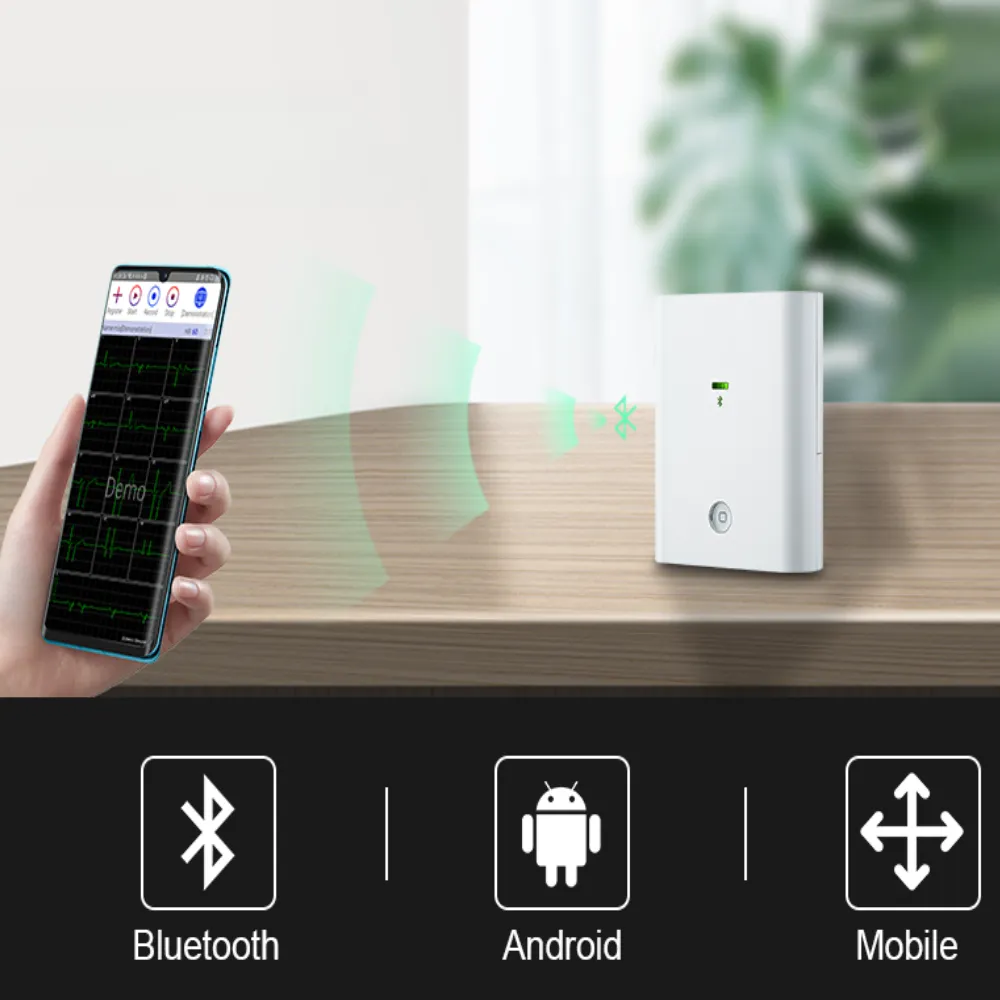
Choose the application documented for the recorder. An app with ECG in its name is not automatically compatible with another manufacturer’s hardware. Android ECG device compatibility depends on the combination being offered, including the hardware revision and software build.
Match the recorder, application, and host
Ask the supplier for the exact application name, publisher, supported recorder models, Android versions, and phone or tablet requirements. If you already own the host devices, provide their model identifiers. A broad statement such as “supports Android” leaves too many details open.
Also ask where the approved application comes from and which license is included. A free download does not establish that all analysis, reporting, storage, or service functions are free. Conversely, do not assume there is a subscription unless the supplier documents one.
The phone’s Bluetooth settings are only one part of the check. Request a demonstration through the offered application, including receiving an authorized test recording and generating the required output. Record the host, operating-system version, and app build used for that demonstration.
Ask about permissions and updates
Android permissions can vary with the operating system and the app’s target software development kit (SDK). Android Developers documents the Bluetooth permission rules.
On Android 12 and later, apps targeting API level 31 or higher must request the applicable runtime permissions for their Bluetooth functions. This general rule does not establish the permissions or target SDK of aECG.
Have your technical team check whether local device-management policies permit the documented application and connection method. Ask who maintains the app, how updates are supplied, and what happens when a host operating system changes. Compatibility needs to remain clear after the initial purchase.
Illustrative scenario: Morgan checks two hosts. Morgan, a fictional technical evaluator, has two Android tablet models available for a new equipment project. Before accepting “Android compatible” as sufficient, they send both model identifiers and operating-system versions to the supplier.
Morgan requests confirmation for the exact recorder and app build in the quotation. One tablet remains an open test item, so the team leaves its use undecided. The equipment proposal now records what has been confirmed and what still needs a demonstration.
A professional option: V&H iCV200 Android ECG
For teams evaluating a professional multi-lead configuration, the V&H iCV200 Android ECG listing describes a recorder for compatible Android smartphones or tablets. It names aECG and includes a patient cable. These are manufacturer-published details; request confirmation for the current offered revision.
Understand the listed features
The manufacturer describes simultaneous 12-channel measurement and analysis, editable doctor comments, PNG/PDF reports, and Bluetooth thermal printing. It also lists selectable recording durations from 10 seconds to one hour. The available choices and functions should be checked against the offered application version.
Automated interpretation is described as “for reference.” Plan for a qualified professional to review the recording and any automated text. A listed software feature does not establish an independent diagnosis or a measured improvement in clinical outcomes.
The additional iCV200 specification listing identifies two AA batteries. Confirm the power arrangement for the quoted unit before planning supplies. Hardware family names alone do not establish that every revision uses identical components.
Verify the complete offered package
Ask whether the quotation includes the Android host, app license, patient cable, electrodes, and any printer. Identify reusable accessories and consumables according to the manufacturer’s documentation. Obtain the actual accessory list instead of inferring inclusions from a product photograph.
For a wireless 12-lead ECG purchase, the relevant comparison is the complete documented system. Confirm the intended examination, supplied equipment, review functions, and output requirements together.
Check your proposed configuration: Share your intended examination, host-device details, and destination market with V&H to request current iCV200 specifications.
How to select Bluetooth ECG for Android equipment
After you understand the device class and app requirements, compare the shortlisted systems against one written requirement list. Clinical staff should define the examination; technical and purchasing teams can then assess how the offered equipment meets it.
Define the acquisition and output requirements
Resting ECG, exercise ECG, and ambulatory Holter monitoring require examination-specific equipment and software. Bluetooth support does not establish suitability for all three. A selectable one-hour recording also does not, by itself, establish Holter capability.
Ask for a sample report generated by the proposed software using de-identified or simulated data. Check the visible patient fields, waveform views, comments, and review information. If you need native waveform data for another application, request its documented export formats separately from the PDF report.
File export and hospital-system integration need different questions. A PDF may be uploaded through an approved document process, but that does not establish a native electronic health record (EHR) interface. Ask which interface is supported, what data it exchanges, and who is responsible for implementation and testing.
Check data responsibilities and the complete cost
Your organization should know where recordings and reports will be stored and who may access or release them. Agree on authorized transfer routes and responsibility for retention, deletion, backup, and lost-device handling. Ask the supplier for documented controls; do not assume the application provides a particular security feature.
Compare costs using the same equipment scope. The recorder price may not answer whether a host, license, printer, consumables, installation, or optional interface is included. Request the price, currency, delivery terms, and ongoing charges for your actual configuration.
| Quotation item | Detail to obtain |
|---|---|
| Recorder and patient connections | Model revision, recording modes, supplied cable, and electrodes |
| Host and application | Device model, operating system, app build, license, and update arrangements |
| Reporting and accessories | Included formats, printer compatibility, paper, and consumables |
| Optional services | Network or interface scope, implementation, and recurring charges if applicable |
| Documentation and support | Model-market documents, training, warranty, and technical escalation |
Request current documentation for the selected model and destination market. Company-level statements, exhibition attendance, or a certificate logo do not establish authorization for every product and country. Check written warranty and support terms for the proposed order as well.
Illustrative scenario: Casey checks the quotation scope. Casey, a fictional distributor, is evaluating a two-recorder proposal for a clinic project. The first quotation names the recorders but leaves host devices and printing unclear. Casey requests a revised item list covering the app licenses, patient accessories, and report-output equipment.
The revised scope lets the clinic compare the proposals on the same basis. An optional interface remains a separate discussion rather than becoming an assumed standard feature. The example illustrates a procurement decision, not a customer result or a claim about V&H’s standard package.
Questions about Bluetooth ECG for Android
Can I do an EKG on my Android phone?
Compatible external hardware is required for the professional ECG system discussed here. The phone or tablet acts as a host; installing an ECG app alone does not turn it into a standard 12-lead recorder. Match the hardware and app to the examination your organization requires.
Are Bluetooth EKGs a thing?
Yes. ECG devices can transmit data through Bluetooth to compatible hosts. The abbreviation EKG does not identify a different technology, and the Bluetooth label does not establish lead count or examination scope. Compare the documented configuration.
Can I use any Android ECG app with any recorder?
No universal compatibility can be assumed. Use the recorder manufacturer’s approved app and installation route, with the supported host and software versions. Confirm the combination before purchasing hardware or assigning existing tablets to the project.
Does Bluetooth mean there are no patient cables?
It depends on the model. The iCV200 Android listing includes a patient cable, while Bluetooth carries data to the host. Review the patient connection arrangement in the current instructions for use rather than interpreting “wireless” as a description of every connection.
Is Bluetooth EKG for Android free to use?
The term does not define a pricing model. An app download, hardware purchase, software license, clinical review service, and optional network feature can have different commercial terms. Ask what the quoted price includes and whether any required function has an ongoing charge.
Choose the configuration, not just the connection
Bluetooth ECG for Android covers a range of devices and applications. Start by identifying the examination and measurements you need. Then confirm the recorder, application, Android host, patient connection, and report functions as one system.
The smallest device, the longest feature list, or the lowest initial price is not enough to decide whether a proposal fits your service. Use the same requirement list for each offer. Keep any unconfirmed host, accessory, interface, or service item visible until the supplier has addressed it.
For a V&H inquiry, prepare the intended examination, proposed host model and Android version, equipment quantity, destination country, and required reports. Add any printer, data-transfer, training, or documentation requirements. Those details make it easier to discuss a specific configuration and understand the quotation.
Request a Bluetooth ECG configuration quotation with your requirements. Ask for current model specifications and an itemized scope, then review the proposal with the relevant clinical and technical teams before selecting equipment.
Post time: November 11, 2026


