


What Is a Stress ECG Test?
A stress electrocardiogram (ECG) test records the heart’s electrical activity while a person exercises. Unlike a resting ECG, which captures cardiac electrical signals when the patient is at rest, a stress ECG test observes how these signals change as physical activity increases.
During exercise, the heart rate and workload increase, placing different demands on the cardiovascular system. Recording the ECG during this process can help clinicians assess changes in cardiac electrical activity and evaluate the patient’s response to exercise.
A Stress ECG Machine is used to acquire, display, and record ECG signals during the test. Depending on the system configuration, the examination may also involve a treadmill or an exercise bicycle, blood pressure monitoring equipment, and computer-based analysis software.
Understanding how the test works, how ECG signals are collected, and which functions are available in the equipment can help healthcare providers and medical equipment buyers make informed decisions.
How Does a Stress ECG System Work?
A stress ECG system follows a sequence of steps, from electrode placement to signal recording and review. Each stage contributes to the collection and presentation of ECG data during exercise.
1. ECG Signal Acquisition
ECG electrodes are attached to the patient’s body to detect electrical signals generated by the heart. These signals are transmitted to an ECG acquisition device, where they are collected for processing.
During exercise, body movement can introduce noise and baseline changes into the recorded signals. The quality of the acquisition device and its signal-processing methods can therefore affect how clearly the ECG waveforms are displayed.
Reliable signal acquisition is particularly important when the patient is walking on a treadmill or exercising on a bicycle, as movement may make signal recording more challenging than during a resting examination.
2. Simultaneous ECG Recording
A stress ECG system can record multiple ECG leads to provide different views of the heart’s electrical activity.
A 12-lead ECG records electrical information from 12 leads, helping clinicians examine cardiac electrical patterns from different perspectives. Simultaneous recording allows the signals from these leads to be captured at the same time, rather than relying on sequential recordings.
A 12 Channel ECG Machine may offer multi-channel display and printing functions, depending on its configuration. When evaluating equipment, buyers should distinguish between the number of recorded leads, the number of displayed channels, and the number of channels available in printed reports.
3. Exercise and Monitoring
Exercise during a stress ECG test is commonly performed using a treadmill or an exercise bicycle. The selected equipment and exercise protocol depend on the clinical requirements and the testing setup.
As exercise progresses, the system records ECG signals for review. Blood pressure monitoring may also be incorporated into the examination when supported by the equipment configuration.
The monitoring process requires coordination between the exercise equipment, ECG acquisition device, and operator. The operator follows the applicable testing protocol and observes the recorded information throughout the examination.
4. ECG Signal Processing and Analysis
After acquisition, ECG signals can be processed and displayed as waveforms.
An ECG Machine With Interpretation can assist with reviewing ECG data by generating measurements or analysis results. However, automated interpretation should be considered an aid to clinical assessment rather than a replacement for professional judgment.
Signal quality, the available software functions, and the clinical context all matter when interpreting recorded results. The specific analysis options differ among systems, so buyers should confirm which functions are included and which are optional.
5. Report Generation
A stress ECG examination may produce printed ECG tracings for review and documentation. Depending on the system, reports can include multiple channels, different paper speeds, and selected sensitivity settings.
Automatic baseline adjustment and configurable print formats can support the presentation of recorded waveforms. Buyers should check the available report formats and printing options against their department’s workflow requirements.
Introducing the CV1200+ Stress ECG System
The CV1200+ is a cardiac stress testing system in the CardioView series. It is designed for ECG acquisition and analysis during stress testing and uses a computer-based workflow with icons and controls.
The system uses an ECG acquisition device and digital processing algorithms designed to provide stable ECG tracings during exercise, including at steep treadmill grades.
Key Features of the CV1200+
12-lead simultaneous ECG recording
The system supports simultaneous 12-lead ECG recording and measurement, providing multi-lead information for cardiac assessment.
Automatic ECG measurement, analysis, and interpretation
The system offers automatic ECG measurements, analysis, and interpretation. Additional software options include vector cardiography (VCG), ventricular late potentials (VLP), and QT dispersion.
ECG acquisition and signal processing
The ECG acquisition device and digital processing algorithms are designed to support stable, low-noise ECG tracings during exercise testing.
Computer-based operation
The operating system options include Windows XP and Windows 7. Buyers should confirm operating system compatibility with their intended computer configuration before purchasing or deployment.
Isolated USB connection
The system includes an isolated USB connection for the ECG acquisition setup.
Multiple printing options
The system supports six-channel and 12-channel printouts, with automatic baseline adjustment. The paper format is A4 Z-fold thermal paper, and supported paper speeds are 12.5, 25, and 50 mm/s. Sensitivity settings are 5, 10, and 20 mm/mV.
Technical Specifications
| Parameter | CV1200+ Specification |
| Monitor | 17-inch color, high-resolution display |
| Operator interface | Standard alphanumeric PC keyboard and mouse |
| Power requirement | 110/230 V, 50/60 Hz |
| Emergency internal power | Up to 3 minutes of uninterrupted power for emergency ECG capability |
| Sampling rate | 1000 Hz/channel |
| Frequency response | 0.05–70 Hz (+3 dB) |
| Common-mode rejection (CMR) | Greater than 90 dB |
| Maximum electrode potential | ±300 mV DC |
| Isolation | 4000 V |
| Patient leakage current | Less than 10 µA |
| Digital resolution | 12 bits |
| Input range | ±10 mV |
| Operating temperature | 10–40°C |
| Storage temperature | -10–50°C |
| Operating pressure | 860–1060 hPa |
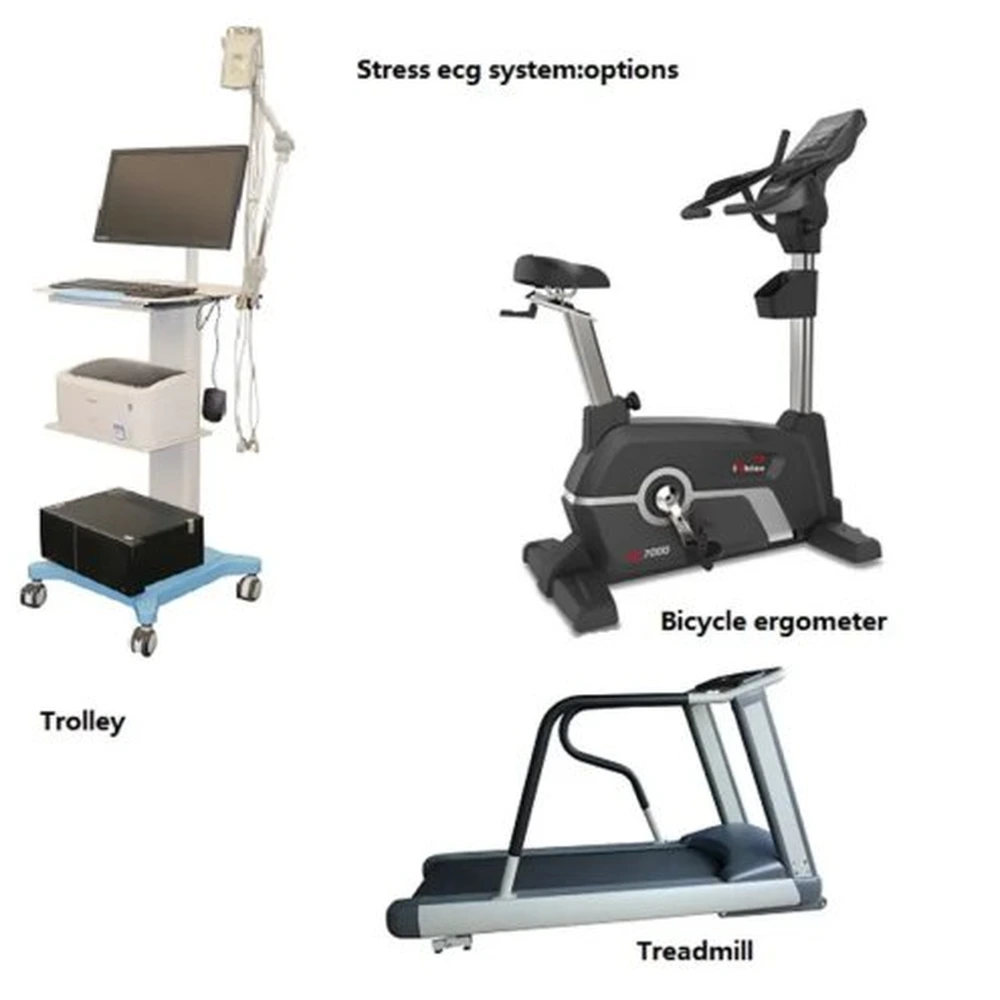
The system also lists a treadmill, exercise bicycle, blood pressure monitor, trolley, computer, and printer among its available options. Buyers should confirm the required configuration, included components, and optional software before placing an order.
Conclusion
A stress ECG system combines ECG signal acquisition, multi-lead recording, signal processing, and reporting to support cardiac assessment during exercise. When selecting equipment, healthcare providers and medical equipment distributors should consider signal quality, recording specifications, analysis functions, connectivity, and configuration requirements.
The CV1200+ brings together simultaneous 12-lead ECG recording, automatic measurement and interpretation, digital signal processing, and configurable printing options in a computer-based stress testing system. Contact us to learn more about the CV1200+ Stress ECG System.
Frequently Asked Questions
1. What is a Stress ECG Machine used for?
A Stress ECG Machine records and displays the heart’s electrical activity during exercise, helping clinicians assess cardiac responses to physical activity.
2. Does the CV1200+ support 12-lead ECG recording?
Yes. The CV1200+ supports simultaneous 12-lead ECG recording and measurement, with automatic ECG analysis and interpretation.
3. What equipment can be used with the CV1200+ Stress ECG System?
Available options include a treadmill, exercise bicycle, blood pressure monitor, trolley, computer, and printer. Buyers can confirm the required configuration before ordering.
Post time: October 28, 2026


